
- The Importance of Reliable Wi-Fi Installation for Modern Businesses
- Advantages of Professional Distributed Antenna Systems Over DIY Setups
- The Expertise of Professional Installers in Wireless Technology
- Customized Design and Strategic Placement for a Wireless Carrier DAS
- Quality Assurance and Testing to Ensure Network Reliability
- Long-Term Support, Maintenance, and Scalability Considerations
- Frequently Asked Questions
- Ensure Total Connectivity and Code Compliance for Your Building
In today’s fast-paced digital world, a building without reliable wireless coverage is a building that simply cannot function. Modern commercial facilities rely on a complex web of signals to keep businesses running, employees productive, and visitors connected. But beyond everyday convenience, this invisible infrastructure plays a critical role in life safety.
When emergencies occur, reliable communication is not just a luxury; it is a matter of life and death.
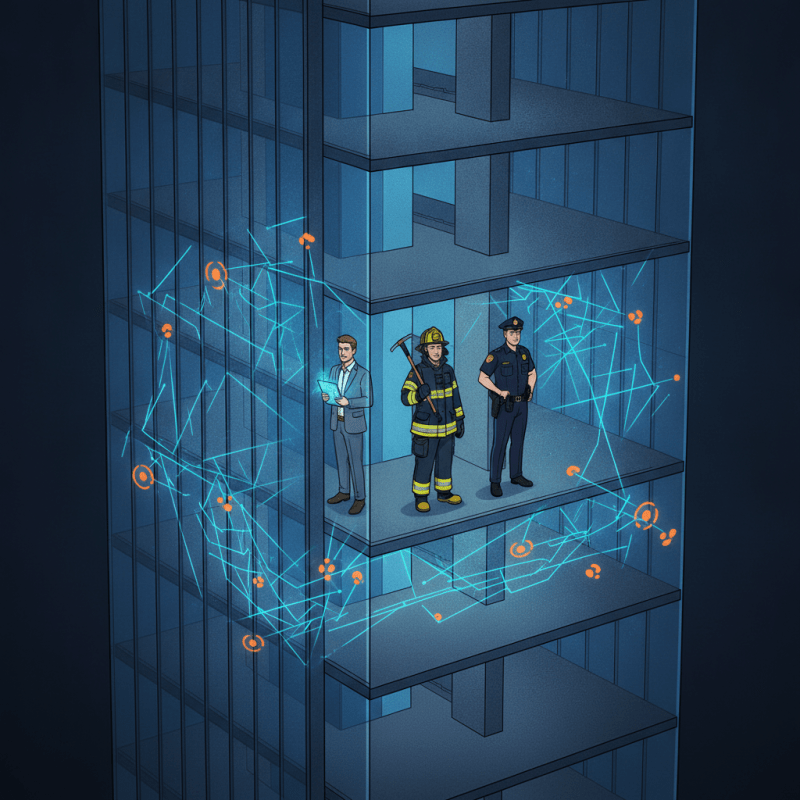
Property owners and facility managers face a unique challenge when constructing or upgrading a commercial space. Modern building materials are excellent for energy efficiency but terrible for wireless signals. Thick concrete, steel frames, and energy-saving glass create invisible barriers that block outside signals from getting in. This results in dead zones where cell phones drop calls, internet connections fail, and most importantly, first responder radios go silent.
Solving this problem requires a comprehensive approach to in-building wireless connectivity. This involves designing a Wireless Carrier DAS to bring cellular signals indoors, setting up robust internet networks, and deploying specialized safety systems. Most importantly, it requires an Emergency Responder Radio Communication System, often referred to as an ERRCS. These public safety systems ensure that firefighters, police, and paramedics can communicate clearly inside your building during a crisis.
This guide will explore the essential steps to designing optimal wireless environments. We will cover the importance of seamless connectivity, the dangers of taking a do-it-yourself approach, and the rigorous testing required to keep your building compliant and safe.
The Importance of Reliable Wi-Fi Installation for Modern Businesses
Every successful commercial enterprise today heavily depends on continuous digital connectivity. From processing point-of-sale transactions to managing cloud-based inventory, businesses cannot afford network downtime. A professional Wi-Fi installation forms the backbone of these daily operations. When networks are slow or spotty, employee productivity drops, customer satisfaction plummets, and operational efficiency grinds to a halt.
However, true connectivity in a large commercial building goes far beyond basic internet access. Modern facilities require a unified wireless strategy. Employees expect their mobile devices to transition smoothly from outdoor cellular towers to indoor networks without dropping a crucial client call. This seamless handoff requires sophisticated technology working quietly behind the scenes to bridge the gap between outside networks and interior spaces.
While business operations rely on internet and cellular connections, facility managers must also consider the most critical communication of all. In an emergency situation, such as a fire or a medical crisis, normal cellular networks often become overwhelmed with traffic. People inside the building might struggle to call for help, and first responders arriving on the scene need their own dedicated, fail-proof communication channels to coordinate rescue efforts.
This is where a public safety Distributed Antenna System steps in as a life-saving solution. Unlike standard Wi-Fi, an ERRCS operates on specific, protected radio frequencies used exclusively by emergency personnel. Property owners must understand that providing a reliable wireless environment means addressing both commercial productivity and public safety mandates simultaneously.
Advantages of Professional Distributed Antenna Systems Over DIY Setups
It is tempting for some building owners to try and cut costs by purchasing off-the-shelf signal boosters or consumer-grade internet routers. For a small residential home, a do-it-yourself approach might be perfectly adequate. However, applying a DIY strategy to a sprawling commercial complex, a high-rise office, or a multi-level parking garage is a recipe for disaster.
Commercial buildings are complex radio frequency environments. Materials like low-emissivity glass, reinforced concrete, and heavy steel structures cause severe signal attenuation, meaning they drastically weaken radio waves. Consumer-grade equipment simply lacks the power and the architectural design required to push signals through these dense physical barriers. As a result, DIY setups almost always lead to frustrating dead zones and dropped connections.
To overcome these architectural challenges, commercial properties require professional Distributed Antenna Systems. A DAS is a network of strategically placed antennas connected to a central controller. This system captures strong signals from the outside, often using a Bi-Directional Amplifier, and distributes those signals evenly throughout the interior of the building. This ensures that every basement, stairwell, and elevator lobby receives a strong, clear signal.
When it comes to emergency communications, DIY setups are not just ineffective; they are entirely illegal. Fire codes require public safety radio systems to meet strict performance metrics that no consumer product can achieve. Professional ERRCS installations utilize industrial-grade Bi-Directional Amplifiers that are certified to withstand high heat, water exposure, and power outages. Trusting this life-saving infrastructure to anyone but specialized experts puts lives at risk and invites severe legal liabilities.
The Expertise of Professional Installers in Wireless Technology
Deploying a high-performance in-building wireless network requires a deep understanding of radio frequency engineering. Professional installers do not simply guess where to place equipment. They possess specialized knowledge regarding how radio waves interact with different physical environments. This expertise ensures that signals do not overlap poorly, which can cause internal interference and degrade network performance.

Expert technicians also utilize advanced predictive modeling software, such as iBwave, before any physical equipment is ever mounted. These sophisticated programs allow engineers to input the architectural blueprints of a building and virtually map out the entire radio frequency environment. By simulating how signals will travel through specific wall types and floors, professionals can design an incredibly accurate and efficient network architecture.
Beyond technical engineering, professional installers bring an indispensable understanding of complex local and national regulations. When dealing with an ERRCS, compliance with strict fire codes is non-negotiable. Professionals are intimately familiar with standards set by the National Fire Protection Association, specifically NFPA 1225, as well as the International Fire Code. These codes dictate everything from signal strength minimums to the required battery backup durations.
Partnering with a specialized company ensures that your building will easily pass rigorous inspections by the local Authority Having Jurisdiction, typically the fire marshal. Attempting to navigate these complex regulatory frameworks without expert guidance almost always results in failed inspections. This leads to costly tear-outs, delayed building occupancy permits, and severe financial headaches for property developers.
Customized Design and Strategic Placement for a Wireless Carrier DAS
The foundation of any successful wireless project begins with a comprehensive site survey. Before designing a Wireless Carrier DAS or an ERRCS, technicians must physically walk the property to measure the existing baseline signal. This process, known as signal benchmark testing, reveals exactly where the outside signals naturally penetrate the building and where the troublesome dead zones are located.
During this survey, professionals pay special attention to critical areas that are notoriously difficult to cover. Subterranean levels, heavily shielded elevator shafts, and enclosed stairwells are often impenetrable to outside radio waves. However, these are the exact locations where first responders frequently need to communicate during an active emergency. Identifying these vulnerable spots is the first step in creating a customized, safety-focused design.
Once the baseline data is collected, engineers carefully plan the strategic placement of all hardware components. They determine the optimal locations for donor antennas on the roof, which pull in the macro network signals. They then route specialized coaxial or fiber-optic cabling down through the building’s infrastructure. Finally, they position the internal broadcast antennas to ensure overlapping, seamless coverage across every square foot of the floor plan.
This customized planning process is vital to prevent signal interference, often called noise, which can cripple a network. If access points or DAS antennas are placed too close together, their signals can clash and cancel each other out. Professional design ensures that the network is perfectly balanced, providing maximum coverage without creating internal friction, thereby guaranteeing crystal-clear communication for both cellular devices and emergency radios.
Quality Assurance and Testing to Ensure Network Reliability
Installation is only halfway to the finish line; rigorous quality assurance testing is what ultimately validates the system. Professional integrators utilize highly specialized tools, such as spectrum analyzers, to measure the exact strength and quality of the newly distributed signals. This ensures that the system performs exactly as the predictive software promised it would.
For public safety systems, testing procedures are heavily regulated and incredibly precise. One of the most critical processes is known as grid testing. Technicians divide the building’s floor plan into an exact grid, typically featuring 20 to 40 squares per floor. They then walk to the center of every single square and manually test the radio signal to ensure it meets the strict minimum thresholds required by the fire code.
Signal strength is important, but clarity is equally crucial during a crisis. Fire marshals require a specific Delivered Audio Quality rating to pass an inspection. This metric ensures that voice communications are not just loud, but also easily understandable over the radio channel without any static or distortion. A strong but distorted signal is useless to a firefighter trying to call for backup in a smoke-filled hallway.
Quality assurance also involves testing the system’s resilience under adverse conditions. Emergency systems must be equipped with dedicated battery backups capable of running the network for up to 24 hours if the main power grid fails. Professionals rigorously test these backup systems, along with all specialized alarms, to guarantee the network will survive and function flawlessly when the building’s occupants need it the most.
Long-Term Support, Maintenance, and Scalability Considerations
An in-building wireless network is not a set-it-and-forget-it appliance; it is a dynamic piece of infrastructure that requires ongoing care. Over time, physical changes to the building environment or updates to outside cellular towers can alter the way signals behave indoors. Routine professional maintenance ensures that the system continues to operate at peak performance year after year.
Continuous monitoring is a critical component of long-term support, especially for life-safety systems. Modern Bi-Directional Amplifiers are equipped with sophisticated internal monitoring panels. If a component fails, an antenna loses connection, or the battery backup drops in voltage, the system immediately triggers a specialized alarm. This allows technicians to address and repair minor issues before they escalate into dangerous system-wide failures.
Annual testing and recertification are also legally mandated for public safety radio systems. Fire marshals require property owners to provide documented proof every year that their ERRCS still meets all local codes. Partnering with a professional maintenance team takes the stress out of this annual requirement. Technicians will perform the necessary grid testing, check the battery health, and submit the required compliance paperwork on your behalf.
Finally, a professionally designed network offers essential scalability for future growth. As a business expands, or as a building undergoes renovations, the wireless infrastructure must adapt. Professional installers design these systems with future capacity in mind. Whether you are adding a new wing to a hospital or changing the layout of an office floor, a well-planned DAS can be smoothly scaled and adjusted to provide continuous, unbroken coverage.
Frequently Asked Questions
What is the difference between a Wireless Carrier DAS and an ERRCS?
A Wireless Carrier DAS is designed to boost commercial cellular signals, like those from AT&T, Verizon, or T-Mobile, to improve smartphone reception for building occupants. An ERRCS, or Emergency Responder Radio Communication System, is a dedicated public safety network. It amplifies specific, protected radio frequencies used by first responders, ensuring they have reliable two-way radio communication during emergencies. While they share similar technology, an ERRCS must meet far stricter fire and building codes.
Why does my new building have dead zones if it was built to modern standards?
Ironically, modern building standards are exactly what cause most dead zones. To meet strict energy efficiency codes, modern structures use dense materials like low-emissivity (Low-E) glass, thick concrete, and heavy steel. These materials are excellent at keeping heat out, but they also act as a shield that blocks outside radio frequency signals from penetrating the building.
What is signal benchmark testing, and why is it necessary?
Signal benchmark testing is an initial site survey where professionals measure the existing radio signal strength inside a building before any equipment is installed. This test identifies exactly where the dead zones are and determines if an amplification system is required by code. It provides the essential baseline data needed to engineer a customized, highly effective wireless design.
How often does a public safety BDA system need to be tested?
According to national fire codes like NFPA 1225 and the International Fire Code, public safety Bi-Directional Amplifier systems must be inspected and tested at least once a year. This annual recertification ensures that the battery backups are functioning, the alarms are active, and the signal strength still meets the minimum requirements mandated by the local fire marshal.
Can my IT department install a Distributed Antenna System?
While IT departments are experts in traditional networking, installing a DAS requires highly specialized radio frequency (RF) engineering knowledge and specific FCC licensing. Furthermore, public safety systems require deep expertise in fire codes and specialized certifications. Because improper installation can cause severe interference with local cell towers or emergency dispatch networks, these systems must be designed and deployed by certified RF professionals.
Ensure Total Connectivity and Code Compliance for Your Building
Providing a safe, productive, and fully connected environment for your building’s occupants requires a comprehensive approach to wireless infrastructure. You cannot afford to leave your digital connectivity to chance, nor can you risk failing critical fire marshal inspections due to inadequate emergency communication systems. Whether you are in the initial design phases of new construction or looking to retrofit an existing structure to eliminate dead zones, specialized expertise is essential.
Don’t let signal blocking materials compromise the safety or efficiency of your commercial property. Reach out to our team of dedicated radio frequency professionals today to schedule a comprehensive site survey and signal benchmark test. We specialize in designing, installing, testing, and maintaining both robust commercial networks and critical life-saving ERRCS solutions. Contact us now to ensure your building remains fully connected, entirely compliant, and ultimately safe for everyone inside.
Ensure Your Building's Safety - Contact Lexico Today