
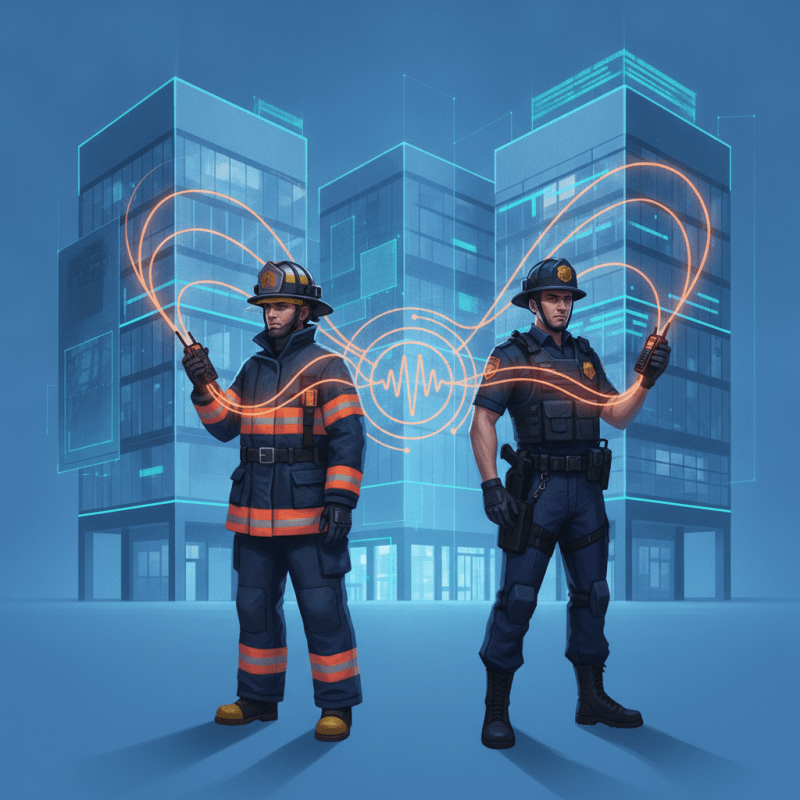
- The Importance of Seamless Communication for Emergency Responder Radio Coverage Systems
- Key Considerations for Emergency Responder Communication Enhancement Systems Design
- Planning Inter-Building Connectivity for Campus-Wide Coverage
- Integration of Distributed Antenna Systems for Optimal Signal Propagation
- Ensuring Regulatory Compliance with NFPA and IFC Standards
- Overcoming Coverage Gaps and Interference in Campus Networks
- The Critical Role of Redundancy Planning in Public Safety Communications
- The Necessity of Annual Recertification and Maintenance for Sustained Reliability
- Frequently Asked Questions
When a crisis strikes a sprawling multi-building campus, clear and immediate communication is the single most critical tool for first responders. Firefighters, police officers, and emergency medical personnel rely heavily on two-way radios to coordinate their life-saving efforts. However, modern building materials and complex architectural designs often act as impenetrable barriers to these essential public safety radio signals. This creates dangerous ‘dead zones’ where responders are completely cut off from dispatch centers and from one another.
To solve this life-threatening problem, property owners and facility managers must invest in specialized in-building wireless solutions. These systems capture external radio signals, amplify them, and distribute them evenly throughout every structure on a campus. Whether you manage a sprawling university, a large corporate headquarters, or a complex medical center, ensuring total radio coverage is both a moral obligation and a strict legal requirement. Navigating the technical and regulatory landscape of these systems can be daunting, but expert guidance makes the process seamless.
In this comprehensive guide, we will explore the critical importance of these specialized communication networks for multi-building environments. We will break down the crucial design considerations, inter-building connectivity strategies, and advanced technological integrations required for optimal performance. Furthermore, we will delve into the strict regulatory compliance, annual testing requirements, and redundancy planning that keep these systems fully operational. By understanding these components, campus administrators can confidently partner with experts like Lexico to ensure total safety and compliance.
The Importance of Seamless Communication for Emergency Responder Radio Coverage Systems
Multi-building campuses present unique and complex challenges for public safety communications. Structures built with dense concrete, thick steel beams, and energy-efficient Low-E glass are notoriously hostile to radio frequency signals. When first responders enter these buildings during an emergency, their portable radios often lose connection with the outside macro network. This sudden loss of communication can delay rescue operations, endanger lives, and create immense confusion during a critical event.
Implementing Emergency Responder Radio Coverage Systems is the definitive solution to this widespread problem. These specialized networks ensure that an emergency responder’s two-way radio works just as well deep inside a basement as it does out on the street. By eliminating signal dead zones, responders can instantly share vital information, request backup, and coordinate safe evacuation routes. This real-time exchange of information drastically reduces response times and improves the overall safety of both the rescue teams and the building occupants.
Furthermore, modern campuses often feature complex architectural layouts, including underground parking garages, sprawling subterranean tunnels, and high-rise towers. Each of these unique areas requires customized signal amplification to guarantee seamless coverage. Without a professionally designed coverage system, first responders are forced to rely on visual cues or human runners, which is highly inefficient and dangerous. Ultimately, a robust public safety radio network is just as vital to a building’s safety infrastructure as its fire sprinklers or smoke alarms.
Key Considerations for Emergency Responder Communication Enhancement Systems Design
The foundation of any successful public safety network begins with a meticulous and highly detailed design phase. Emergency Responder Communication Enhancement Systems cannot be purchased off the shelf and simply plugged in; they require customized engineering. The process starts with a comprehensive site survey conducted by highly trained radio frequency engineers. During this survey, technicians walk the entire campus with specialized spectrum analyzers to measure existing signal strength and identify exact areas of weakness.
Identifying critical areas is a major priority during this initial testing phase. Fire codes strictly mandate enhanced signal strength in locations deemed vital for emergency operations. These critical areas typically include stairwells, elevator lobbies, fire pump rooms, and emergency command centers. If the initial benchmark testing reveals failing signal levels in these specific zones, the engineering team must design a targeted amplification strategy to bring them up to code.
To ensure flawless execution, professional design teams utilize advanced predictive modeling software, such as iBwave. This technology allows engineers to input a building’s floor plans and construction materials to simulate how radio waves will travel through the space. By creating a virtual heat map of the facility, designers can precisely determine where to place amplifiers, cables, and antennas. This highly scientific approach guarantees that the final installation will meet all strict regulatory requirements on the very first try.
Planning Inter-Building Connectivity for Campus-Wide Coverage
Securing consistent radio coverage across a single building is challenging, but connecting multiple separate structures on a campus requires advanced networking strategies. The goal is to create a unified system where a responder can walk from an underground garage in Building A to the penthouse of Building B without ever dropping their radio signal. To achieve this, engineers must design a robust inter-building connectivity plan. This often involves designating one building as the primary hub to house the master head-end equipment.
The gold standard for linking multiple buildings together is the use of dedicated fiber-optic cables. Fiber-optic technology allows massive amounts of radio frequency data to travel over long distances with zero signal degradation. Engineers will route these high-speed fiber cables through underground conduits, connecting the master control unit to remote amplification units located in each surrounding building. This creates a highly reliable and lightning-fast backbone for the entire campus safety network.
In situations where laying underground fiber is physically impossible or cost-prohibitive, wireless point-to-point links can serve as an effective alternative. These secure microwave connections beam signals through the air from one rooftop to another, bridging the gap between separate structures. Additionally, secure Ethernet connections can be utilized to monitor the health and status of the equipment across the entire campus. A well-planned combination of these connectivity methods ensures that the network remains resilient, unified, and ready for any emergency scenario.
Integration of Distributed Antenna Systems for Optimal Signal Propagation
At the very heart of these life-saving networks is the strategic integration of Distributed Antenna Systems. A Distributed Antenna System, commonly referred to as a DAS, is a network of spatially separated antennas connected to a common source. Instead of relying on one massive antenna to push a signal through an entire building, a DAS uses multiple smaller antennas strategically placed throughout the facility. This method effectively bypasses thick walls and floors, distributing the public safety radio signal evenly across every square foot of the campus.
To make this system work, a crucial component known as a Bi-Directional Amplifier, or BDA, is integrated into the network. The BDA acts as the powerful engine of the system, capturing weak signals from the outdoor macro network via a rooftop donor antenna. The BDA then amplifies this signal and pushes it down through the internal cable pathways to the various indoor antennas. Just as importantly, it works in reverse, taking the weak signals from the first responders’ radios inside and amplifying them back out to the dispatch center.
There are generally two types of configurations used in these setups: active and passive systems. A passive system uses thick, rigid coaxial cables and physical splitters to distribute the signal, which is highly effective for smaller or single-building deployments. An active system, which is essential for large multi-building campuses, converts the radio frequency into optical light to travel over fiber-optic cables. Active systems prevent signal loss over long distances, ensuring that every remote corner of the campus receives the optimal signal strength required for safe emergency operations.
Ensuring Regulatory Compliance with NFPA and IFC Standards
Installing a public safety radio system is not a voluntary upgrade; it is a strict legal requirement governed by complex building and fire codes. The two primary bodies that dictate these regulations are the National Fire Protection Association (NFPA) and the International Fire Code (IFC). Specifically, guidelines such as NFPA 1225 and IFC Section 510 outline the exact technical specifications that every system must meet. Failure to comply with these rigorous standards can result in delayed building occupancy permits, hefty fines, or forced facility shutdowns.
One of the most critical regulatory requirements involves specific signal strength thresholds and coverage percentages. Codes generally mandate that 99 percent of all critical areas, like fire command centers and exit stairs, must have passing signal strength. General building areas typically require 95 percent coverage. To prove compliance, technicians must perform a highly structured grid test, dividing the floor plan into equal squares and testing the radio signal in the center of each one.
The final approval for these systems rests solely with the local Authority Having Jurisdiction, often the local fire marshal or building inspector. Because local municipalities can amend and add to national codes, close collaboration with the Authority Having Jurisdiction is absolutely essential throughout the entire project. Professional installation partners like Lexico specialize in navigating these local nuances, ensuring that all equipment uses proper NEMA-rated waterproof enclosures, meets specific battery backup timelines, and complies with all local FCC licensing requirements.
Overcoming Coverage Gaps and Interference in Campus Networks
Even with the best equipment available, designing a radio enhancement network is a complex science that must overcome numerous environmental obstacles. One of the most common challenges engineers face is radio frequency interference, which can severely degrade communication clarity. Interference often occurs when an internal system is too ‘loud’ and begins to push noise back onto the outdoor public safety macro network. If left unchecked, this noise can disrupt communications for first responders operating miles away from the campus.
To prevent this, engineers must carefully manage system gain and utilize advanced filtering technologies. Modern amplification equipment features highly sophisticated channelized filters that only allow specific, approved public safety frequencies to pass through. This surgical precision ensures that unwanted cellular signals or commercial radio waves are completely blocked out. By fine-tuning these filters, technicians guarantee a crystal-clear channel exclusively dedicated to emergency personnel.
Another major obstacle is the phenomenon known as signal oscillation, which is essentially a destructive feedback loop similar to placing a microphone too close to a speaker. This occurs when the indoor antennas are positioned too closely to the outdoor donor antenna. To resolve this, expert installers use highly precise predictive modeling to ensure adequate spatial isolation between the antennas. When necessary, they also deploy advanced adaptive antenna systems that can automatically adjust their power levels to eliminate coverage gaps while maintaining a stable, oscillation-free environment.
The Critical Role of Redundancy Planning in Public Safety Communications
During a severe emergency, such as a large-scale fire or a natural disaster, a building’s primary infrastructure is highly likely to fail. Power grids go down, cables can be severed, and equipment can be compromised by extreme heat or water damage. Because first responders rely on the internal radio network to survive, this system cannot afford to go offline during a crisis. Therefore, comprehensive redundancy planning is a mandatory aspect of any professional installation.
The most critical element of redundancy is dedicated, uninterruptible backup power. Fire codes require that all amplification equipment be connected to a robust Battery Backup Unit (BBU). Depending on the specific local regulations, these backup batteries must be capable of powering the entire system for 12 to 24 hours after a total loss of building power. These battery enclosures are typically rated to withstand water spray from fire hoses and are securely mounted in protected areas of the facility.
Beyond power loss, the system must also actively monitor itself for any internal hardware failures. Codes mandate that the radio enhancement network must be directly integrated into the building’s main fire alarm control panel. If a component fails, a cable is cut, or the backup battery runs low, the system immediately sends a supervisory alarm to the fire panel. This instant notification ensures that facility managers are immediately aware of the issue and can dispatch repair technicians before an actual emergency occurs.
The Necessity of Annual Recertification and Maintenance for Sustained Reliability
Achieving initial compliance and securing a certificate of occupancy is only the first step in managing a public safety communication network. Over time, physical building changes, internal renovations, and natural degradation of electronic components can negatively impact system performance. Furthermore, changes to the external city environment, such as a new high-rise being built next door, can block the signal reaching your rooftop donor antenna. Because of these shifting variables, ongoing maintenance is absolutely critical.
To guarantee sustained reliability, local fire codes universally require an annual recertification of the entire system. During this mandatory yearly inspection, certified technicians must return to the property to perform a full system audit. This involves re-running the extensive grid testing to ensure coverage percentages have not dropped below the legal thresholds. Technicians will also perform rigorous load testing on the backup batteries to verify they can still hold a full, code-compliant charge.
Partnering with a dedicated service provider for this ongoing maintenance is the best way to protect your investment and ensure continuous safety. Experts at Lexico provide meticulous annual testing, detailed compliance reporting, and rapid emergency repair services. By keeping your system perfectly tuned and fully documented, facility managers can pass their annual fire inspections with ease. Most importantly, proactive maintenance guarantees that when a crisis does occur, the system will perform flawlessly, protecting the lives of both building occupants and the brave responders rushing in to help.
Frequently Asked Questions
What is the difference between ERRCS and ERCES?
There is no functional difference between the two terms; they are essentially interchangeable acronyms used within the industry. ERRCS stands for Emergency Responder Radio Coverage Systems, while ERCES stands for Emergency Responder Communication Enhancement Systems. Both terms describe the exact same network of bi-directional amplifiers and distributed antennas used to boost public safety radio signals inside a building. Different fire codes or local municipalities may prefer one term over the other, but the life-saving technology remains identical.
Are Distributed Antenna Systems mandatory for all buildings on a campus?
Whether a system is legally mandated depends heavily on the specific building’s size, its construction materials, and the strictness of the local Authority Having Jurisdiction. Generally, most new commercial construction projects, high-rise buildings, and large campus facilities are required to undergo radio signal testing before they can open. If the initial benchmark testing shows that the natural radio signal is too weak to support emergency communications, the installation of an enhancement system becomes a mandatory legal requirement for occupancy.
How long does a site survey and benchmark test usually take?
The duration of a site survey is entirely dependent on the square footage and architectural complexity of the campus. For a single, medium-sized commercial building, a certified technician can often complete the grid testing and spectrum analysis in one to two days. However, for a sprawling multi-building university or a massive hospital campus, the survey process can take several weeks of meticulous floor-by-floor testing. A professional installation company will provide a detailed timeline prior to beginning the assessment.
What does the annual maintenance and recertification process involve?
Annual maintenance is a comprehensive health check required by the fire code to ensure the system is still operating at peak performance. A licensed technician will inspect all physical equipment, ensure the NEMA enclosures are secure, and verify that the system is properly communicating with the fire alarm panel. They will also perform a full grid test of the building’s interior to confirm signal strength hasn’t degraded. Finally, they will conduct a strict load test on the backup batteries to ensure they can provide the legally required hours of emergency power.
Navigating the complexities of campus-wide emergency communication networks requires a high level of technical expertise and a deep understanding of local fire codes. Ensuring that your multi-building facility is fully compliant and optimized for first responders is not a project that can be left to chance. The highly trained engineering and installation teams at Lexico specialize in delivering end-to-end solutions, from the initial predictive modeling and site surveys to expert installation and mandatory annual maintenance. Don’t wait for a critical emergency to discover that your facility suffers from dangerous communication dead zones. Reach out to the professionals at Lexico today to request a comprehensive consultation and secure the safety of your entire campus.
Ensure Your Building's Safety - Contact Lexico Today