
- Achieving Emergency Responder Radio Coverage Through Comprehensive Site Surveys
- Prioritizing Critical Areas for Reliable Emergency Responder Radio Coverage
- Planning Backhaul Infrastructure for Campus Distributed Antenna Systems
- Integration of Distributed Antenna Systems Across Multiple Facilities
- Ensuring Regulatory Compliance for Campus ERCES Installations
- Sustaining Emergency Responder Radio Coverage with Annual Recertification
- Frequently Asked Questions About Campus Distributed Antenna Systems
Securing clear and reliable communication for first responders is a massive responsibility for property owners. When an emergency strikes on a large campus, police, firefighters, and paramedics must be able to talk to one another seamlessly. However, modern building materials and sprawling layouts often block these critical radio signals. This creates dangerous communication dead zones exactly when help is needed most.
Designing a radio enhancement system for a single structure is complex, but scaling that across a multi-building environment multiplies the difficulty. A hospital network, a corporate headquarters, or a university campus features diverse building materials, underground structures, and vast square footage. Overcoming these obstacles requires advanced technology and highly specialized engineering.
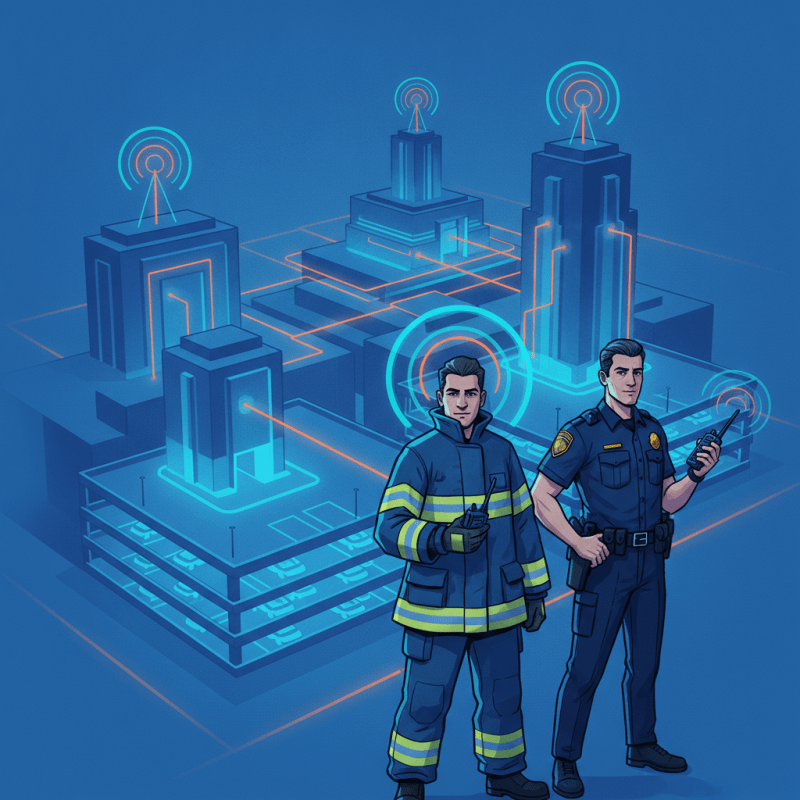
Public safety radio enhancement systems, commonly known as Emergency Responder Radio Communication Systems, are the standard solution to this problem. These networks capture outdoor public safety signals, amplify them, and distribute them evenly throughout indoor spaces. Implementing these systems across a wide area requires a strategic approach to design, installation, and ongoing management.
This guide will explore the unique challenges of multi-building campus environments. We will uncover how specialized testing, strategic design, and strict maintenance ensure life-saving communication. By understanding these concepts, campus facility managers can confidently navigate the path to complete radio coverage and maximum safety.
Achieving Emergency Responder Radio Coverage Through Comprehensive Site Surveys
The foundation of any successful campus radio enhancement project is a highly detailed site survey. Before engineers can design a system, they must understand exactly how radio waves behave across the entire property. In a multi-building environment, this behavior is often unpredictable and varies wildly from one structure to the next. Comprehensive signal benchmark testing is required to map out the baseline radio environment.
During a campus site survey, specialized technicians use spectrum analyzers to measure the strength of incoming public safety radio frequencies. They walk through every floor of every building to record the Received Signal Strength Indicator, or RSSI. They also measure the Delivered Audio Quality, which determines if a voice transmission is actually clear enough to understand. This process identifies exactly where communication dead zones exist across the property.
One of the biggest challenges discovered during these surveys is radio frequency interference. Campuses are often filled with competing signals from cellular networks, heavy machinery, medical equipment, and dense Wi-Fi networks. A thorough survey identifies this RF interference so engineers can design filters to block unwanted noise. Without this step, the final radio system might amplify the wrong signals, causing the entire network to fail.
Furthermore, site surveys dictate the optimal placement for the donor antenna. The donor antenna is the equipment placed on the roof that communicates directly with the city or county radio tower. On a sprawling campus, finding the perfect line of sight to the emergency radio tower can be difficult. The initial survey ensures the donor antenna is placed on the tallest or most strategically located building to capture the strongest possible signal.
Prioritizing Critical Areas for Reliable Emergency Responder Radio Coverage
When designing a system for a large campus, not all physical spaces are treated equally by fire codes. Fire authorities place the highest priority on specific zones known as critical areas. These are the locations where first responders absolutely must have clear communication to coordinate rescue efforts. Identifying and prioritizing these zones is a major step in the design phase.
Fire codes, such as those established by the National Fire Protection Association, require 99 percent signal coverage in these critical areas. Critical areas typically include fire command centers, stairwells, elevator lobbies, and locations with standpipe cabinets or sprinkler valves. These zones are vital for navigating the building and controlling fire suppression systems during a crisis.
High-occupancy buildings and sprawling parking structures also require special attention. Underground parking garages are notoriously bad for radio signals because they are surrounded by thick concrete and earth. Because these garages often serve as staging areas or evacuation routes, they must be blanketed with strong radio coverage. Engineers often have to design highly dense networks of indoor antennas specifically for these subterranean spaces.
Basements and mechanical rooms are equally challenging but highly critical. When a fire breaks out, first responders often need to access the basement to shut off utilities or manage HVAC controls. Because these rooms are buried deep inside the building core, they naturally block all outside radio waves. A well-designed system ensures that Bi-Directional Amplifiers push strong, clear signals into these deep internal spaces.
Planning Backhaul Infrastructure for Campus Distributed Antenna Systems
Linking multiple buildings together requires a robust and reliable backhaul infrastructure. In a single building, an amplifier simply pushes the signal through coaxial cables to indoor antennas. However, pushing a radio signal across hundreds of yards to a completely different building requires a much more advanced network. If the connection between buildings fails, the remote structures will instantly lose their emergency radio coverage.
Fiber-optic cables are the gold standard for connecting multiple buildings on a campus. In a fiber-based architecture, a master unit sits in the main building and converts the radio signal into pulses of light. This light travels through underground fiber-optic cables to remote units located in the surrounding buildings. The remote units then convert the light back into a radio frequency and broadcast it throughout their respective structures.
Using fiber-optic cables prevents signal degradation over long distances. Coaxial cables lose signal strength very quickly, making them useless for connecting structures that are far apart. Fiber optics allow the signal to travel miles without losing any quality or power. This centralized design also means the campus only needs one main donor antenna on the roof of the primary building, reducing potential interference.
In some cases, trenching underground fiber-optic cables between buildings is physically impossible or too expensive. When this happens, engineers might design secure wireless point-to-point links. These microwave links shoot a focused beam of data between the roofs of the campus buildings to share the signal. While fiber is preferred for its physical security, wireless links provide a highly effective solution when underground pathways are blocked.
Integration of Distributed Antenna Systems Across Multiple Facilities
At the heart of every emergency radio enhancement project is the Distributed Antenna System. This system is a carefully engineered network of cables, splitters, and small indoor antennas placed strategically throughout a building. On a large campus, integrating these systems across multiple distinct facilities requires careful planning and top-tier equipment. The goal is to make all the separate buildings function as one unified radio environment.
Engineers use advanced 3D modeling software, such as iBwave, to design these systems before a single wire is pulled. They input the blueprints of every campus building and assign specific materials to the walls, windows, and floors. The software then predicts exactly how the radio signal will flow through the space. This prevents expensive mistakes and ensures the right equipment is chosen from trusted manufacturers like Nextivity, Fiplex, Comba, ADRF, or Westell.
For campus environments, an active Distributed Antenna System is almost always required. While a passive system only uses basic cables and splitters, an active system uses powered equipment to boost the signal at multiple points. Active systems can push signals much further, making them ideal for massive sprawling facilities. The master and remote units work together to guarantee that the signal is just as strong on the far edge of the campus as it is near the main amplifier.
Bi-Directional Amplifiers, or BDAs, act as the central brain for the signal distribution. They amplify the signal coming from the emergency tower and push it into the building, while simultaneously taking the signal from the first responder’s radio and pushing it back outside. Integrating these amplifiers across multiple buildings requires precise tuning. If the amplifiers are turned up too high, they can cause a feedback loop that disrupts the city’s main radio tower.
Ensuring Regulatory Compliance for Campus ERCES Installations
Navigating the legal and regulatory landscape is often the most demanding part of a campus radio project. These life-safety networks are strictly governed by local, state, and federal laws. A system can have perfect radio coverage, but if it fails to meet the exact legal specifications, the building will not receive its certificate of occupancy. Regulatory compliance must be woven into every step of the design and installation process.
The National Fire Protection Association outlines the primary rules for these systems, specifically within NFPA 1225. Additionally, the International Fire Code addresses these requirements under IFC Section 510. These national codes mandate everything from the required signal strength to the physical durability of the equipment. For example, all critical equipment must be housed in waterproof NEMA 4 or NEMA 4X enclosures to protect them from fire sprinkler water.
Beyond national codes, the local Authority Having Jurisdiction has the final say on all compliance matters. The AHJ is typically the local fire marshal or building inspector. Local rules often differ slightly from national codes, with specific requirements for fire alarm integration or dedicated electrical circuits. A trusted integration partner like Lexico ensures that the campus design meets the precise expectations of the local AHJ from day one.
Finally, Federal Communications Commission regulations play a major role in campus systems. The FCC requires that these powerful signal boosters do not interfere with other cellular or public safety networks. All equipment must be FCC-certified, and the property owner must obtain the proper retransmission agreements from the local frequency license holders. Failing to register the system or causing interference can result in massive federal fines and an immediate system shutdown.
Sustaining Emergency Responder Radio Coverage with Annual Recertification
Designing and installing a campus radio system is only the beginning of the journey. Once the system is live, it must be properly maintained to ensure it works perfectly during a future emergency. Building structures settle, new high-rises are built nearby, and electronic components age over time. Because the radio frequency environment is constantly changing, ongoing maintenance is an absolute necessity.
Fire codes mandate that all public safety radio systems undergo an annual recertification process. During this annual checkup, technicians return to the campus to perform grid testing all over again. They divide the floor plans into small grid squares and test the radio signal in every single square. This ensures that no new dead zones have appeared over the past twelve months due to new construction or equipment degradation.
Testing the battery backup systems is another critical part of the annual maintenance routine. During a severe fire, the main AC power to the campus will likely be cut off. Codes require these life-safety systems to run on dedicated battery backups for 12 to 24 hours. Technicians must physically test these batteries under load to ensure they can sustain the system for the fully mandated duration.
The system’s connection to the campus fire alarm panel must also be rigorously tested. If the radio system experiences a failure, such as a low battery or a damaged antenna, it must instantly trigger an alert on the main fire alarm panel. Annual maintenance verifies that these supervisory alarms are working correctly. By partnering with Lexico for ongoing service, property managers can rest easy knowing their campus remains compliant, functional, and fully prepared for any emergency.
Frequently Asked Questions About Campus Distributed Antenna Systems
What is the difference between a single-building and campus radio enhancement system?
A single-building system usually features one donor antenna on the roof and a single amplifier inside. A campus system connects multiple buildings together, often using fiber-optic cables. It utilizes a centralized master unit that distributes the radio signal to remote units located in surrounding buildings, acting as one massive, unified network.
How long does it take to design a multi-building public safety radio system?
The timeline varies based on the size and complexity of the property. A comprehensive site survey alone can take several days for a large campus. Following the survey, specialized engineers typically spend a few weeks drafting a precise 3D blueprint to ensure 100 percent regulatory compliance before installation begins.
Who enforces regulatory compliance for these life-safety systems?
The local Authority Having Jurisdiction, usually the local fire marshal or fire code official, acts as the primary enforcer. They review the design plans, witness the final grid testing, and issue the final approval. The Federal Communications Commission also enforces strict rules regarding signal interference.
What happens if a campus fails its annual recertification testing?
If a campus fails its annual inspection, the building owner will be issued a citation and given a specific timeframe to fix the issues. Ignoring these repairs can result in heavy fines or, in extreme cases, the revocation of the building’s certificate of occupancy. Prompt maintenance and repairs are critical to staying compliant.
If you are managing a large property or planning a multi-building development, ensuring reliable communication for first responders is not just a legal requirement, it is a moral obligation. The complexities of campus-wide radio enhancements demand a partner with specialized engineering expertise and a deep understanding of fire codes. Lexico provides end-to-end solutions, from the initial comprehensive site survey and advanced system design to professional installation and annual maintenance. Do not leave the safety of your occupants to chance. Contact the team at Lexico today to request a thorough consultation and secure life-saving communication across your entire campus.
Ensure Your Building's Safety - Contact Lexico Today