
- The Core Challenge of Public Safety Communications Interoperability
- Why In-Building Environments Compound the First Responder Communication Problem
- The Unified Solution: Emergency Responder Radio Communication Systems (ERRCS)
- How BDAs Achieve True Multi-Agency Communication
- The Importance of Professional ERRCS Design and Installation
- Ensuring System Readiness with Critical ERRCS Testing and Compliance
- Maintaining Peak Performance for Long-Term Public Safety
- Frequently Asked Questions About Public Safety Communications
During a large-scale emergency, clear communication is the most critical tool for first responders. It is the invisible thread that connects firefighters in a burning building to their command center, police officers coordinating a response, and paramedics relaying vital information. When this thread breaks, chaos follows. The ability for different agencies to talk to each other seamlessly is called interoperability, and its failure can have devastating consequences. True public safety communications interoperability means that a police officer, a firefighter, and a paramedic can all communicate effectively, regardless of the brand or band of radio they use. This guide explores the deep challenges of achieving this goal, especially inside modern buildings, and details the definitive solution that keeps our heroes connected and our communities safe.
The Core Challenge of Public Safety Communications Interoperability
The fundamental problem with multi-agency communication is that different public safety departments often operate in their own technological silos. For decades, police departments, fire departments, and Emergency Medical Services (EMS) developed their radio networks independently. This led to a patchwork of systems across cities and counties, creating a significant barrier to a unified emergency response. When multiple agencies arrive at a single incident, they may find their radios are simply unable to talk to each other.
Technical and Logistical Hurdles
The technical reasons for this lack of connection are complex. Public safety agencies broadcast on different radio frequency bands, such as VHF (Very High Frequency), UHF (Ultra High Frequency), and the more modern 700/800 MHz bands. A radio designed for one band cannot typically receive or transmit on another. It’s like trying to tune an AM radio to an FM station; the technologies are fundamentally incompatible. This forces responders to carry multiple radios or rely on dispatchers to relay messages, a slow and error-prone process in a life-or-death situation.
Logistical issues further complicate the matter. Upgrading an entire region to a single, unified radio system is incredibly expensive and requires immense political coordination between different towns, cities, and jurisdictions. As a result, many areas continue to operate with these legacy, non-compatible systems. This means that during a major event requiring a multi-agency response, the most basic tool—voice communication—becomes the biggest obstacle.
Why In-Building Environments Compound the First Responder Communication Problem
Even if first responders have radios that can talk to each other, a new and dangerous challenge emerges the moment they step inside a building. Modern construction materials are the enemies of radio waves. Materials like concrete, metal studs, steel beams, and energy-efficient Low-E glass effectively create a cage that blocks radio frequency (RF) signals from entering or leaving the structure. This phenomenon turns large parts of buildings into communication ‘dead zones’.
These dead zones are most common in areas that are often critical during an emergency. Basements, underground parking garages, thick-walled stairwells, elevator shafts, and even the center core of high-rise buildings can become completely isolated from outside radio signals. A firefighter in a basement may be unable to call for help, and a police officer clearing a stairwell may be cut off from their team. This isolation is not just an inconvenience; it is a direct threat to responder safety and the effectiveness of their mission.
This in-building signal loss makes the interoperability problem drastically worse. The challenge is no longer just about getting different agencies to talk to each other. It’s about ensuring any of them can communicate at all once they are inside a building. The mission-critical link to the incident commander outside is severed, leaving emergency crews disconnected and vulnerable at the most dangerous moments.
The Unified Solution: Emergency Responder Radio Communication Systems (ERRCS)
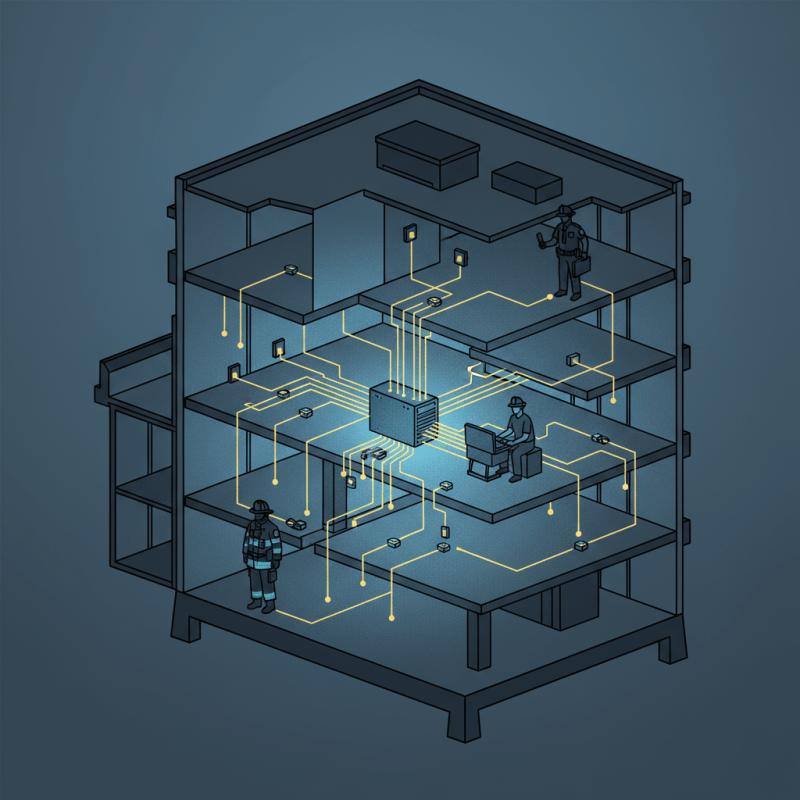
To combat the issue of in-building dead zones, fire codes and telecommunication regulations have mandated a powerful solution: Emergency Responder Radio Communication Systems (ERRCS). Sometimes called a Public Safety DAS (Distributed Antenna System), an ERRCS is a dedicated in-building wireless solution designed specifically to amplify and distribute public safety radio signals throughout a building, ensuring reliable coverage everywhere.
An ERRCS is not just a single piece of equipment but a complete, engineered system with three primary components working in harmony. Understanding these parts helps clarify how the system overcomes signal-blocking building materials to guarantee clear communication.
The Donor Antenna
Think of the donor antenna as the system’s ears. Typically installed on the roof of the building, this powerful antenna is strategically aimed at the nearest public safety radio tower. Its sole job is to capture the clean, strong radio signals from the outside and pull them into the system. It must be positioned carefully to avoid interference and to find the best possible signal source.
The Bi-Directional Amplifier (BDA)
If the donor antenna is the ears, the Bi-Directional Amplifier (BDA) is the powerful voice and brain of the operation. This device, also known as a public safety signal booster, receives the signal from the donor antenna, filters out any unwanted noise, and dramatically boosts its strength. Crucially, it works in two directions. It amplifies the incoming signal for responders inside the building and amplifies the signal from their handheld radios back out, ensuring their transmissions reach the command center.
The Distributed Antenna System (DAS)
The Distributed Antenna System, or DAS, is the delivery network. It is a carefully mapped-out web of specialized, low-loss coaxial cables and indoor antennas that run throughout the building. The powerful signal from the BDA is sent through these cables to antennas placed in stairwells, hallways, basements, and other critical areas. This network acts like a sprinkler system for radio signals, guaranteeing that strong, clear coverage is spread evenly across every floor and corner, eliminating dead zones entirely.
How BDAs Achieve True Multi-Agency Communication
The Bi-Directional Amplifier (BDA) is the key component that directly solves the interoperability challenge inside a building. While older signal boosters were often limited to a narrow range of frequencies, modern BDAs are sophisticated, programmable devices. They can be configured to capture and amplify signals across all the major public safety bands used in a specific region, including VHF, UHF, and 700/800 MHz, all at the same time.
This capability is a game-changer for first responder communication. When a building is equipped with a properly configured ERRCS, it becomes a universal communication hub. It doesn’t matter if a firefighter is using a VHF radio and a police officer is using an 800 MHz radio. The system captures both signals, amplifies them, and re-broadcasts them throughout the building on their native frequencies. This allows different agencies to communicate seamlessly within the structure, creating a unified and safer operational environment.
The BDA essentially makes the building’s infrastructure the common ground for communication. It ensures that every first responder, regardless of their agency, has a clear, reliable signal. This allows for direct coordination, faster response times, and a dramatic increase in operational safety for everyone involved. It breaks down the technological silos and ensures everyone is on the same page when lives are on the line.
The Importance of Professional ERRCS Design and Installation
An ERRCS is a life-safety system, and its installation is not a job for a general contractor or electrician. It requires the deep, specialized expertise of certified technicians who understand radio frequency engineering and complex fire code regulations like NFPA 1225 and IFC 510. A poorly designed or installed system can fail to provide coverage, or worse, it can cause dangerous radio frequency interference with the public safety network, leading to fines and system shutdown.
RF Surveys and System Design
The first step in any professional installation is a thorough RF benchmark survey. A technician uses a specialized spectrum analyzer to measure the strength of public safety radio signals from all relevant agencies on the building’s roof and throughout its interior. This data is essential for determining if a system is needed and for designing it correctly. Using this information, engineers use advanced software like iBwave to create a detailed digital model of the building. This model predicts signal coverage and allows them to precisely plan the placement of every cable and antenna to guarantee the required 99% coverage in critical areas.
Equipment Selection and Installation
Based on the design, the team selects the right FCC-certified equipment from leading manufacturers such as Nextivity, Fiplex, Comba, and ADRF. This ensures the BDA, antennas, and all other components are reliable and compliant with strict federal regulations. The installation process itself is meticulous. Technicians run specialized plenum-rated or riser-rated cables, mount antennas securely, and connect the BDA to the building’s power and fire alarm systems. This careful work ensures the system will perform flawlessly for years to come.
Ensuring System Readiness with Critical ERRCS Testing and Compliance
After the physical installation is complete, the system must undergo a rigorous ERRCS testing and commissioning process before it can be approved by the local Authority Having Jurisdiction (AHJ), which is typically the Fire Marshal. This testing is not optional; it is a mandatory step to verify that the life-safety system performs exactly as designed and meets all code requirements. The goal is to prove, without a doubt, that the system will work during an actual emergency.
The Commissioning and Grid Testing Process
The most important part of this phase is the signal coverage test, often called ‘grid testing’. The building is divided into a grid of squares, typically 20 or 40 per floor, depending on the local code. A technician walks to every single grid square with a public safety radio and tests the communication link with the external network. They measure the signal strength in each grid to confirm it meets the required level, which is usually -95 dBm or better. This methodical process confirms that there are no remaining dead zones.
Alarm Integration and Acceptance
In addition to signal coverage, the system’s alarms must be tested. The ERRCS must be monitored by the building’s fire alarm panel. If the BDA loses power, a battery backup fails, or an antenna malfunctions, an alert must be sent to the monitoring station. This ensures that any issues with the system are identified and fixed immediately. Once all tests are passed and the results are documented in a detailed report, the Fire Marshal conducts a final inspection. This acceptance test is the final approval that certifies the building as compliant and safe for occupancy.
Maintaining Peak Performance for Long-Term Public Safety
An ERRCS is not a ‘set it and forget it’ device. Like any critical life-safety system, such as a fire alarm or sprinkler system, it requires ongoing maintenance and inspection to ensure it remains reliable. Most jurisdictions, following NFPA 1225 standards, mandate that every public safety DAS be inspected, tested, and recertified on an annual basis. This is not just a formality; it is essential for guaranteeing the system is ready to perform when it is needed most.
This annual recertification process involves a comprehensive system checkup. A certified technician will re-test signal coverage to ensure no new dead zones have appeared due to building renovations or changes in the external radio network. They will test the battery backup system to confirm it can power the BDA during a power outage. They inspect all cabling and antennas for damage and verify that the fire alarm panel connections are still functioning correctly. This proactive maintenance protects the building owner’s investment and, more importantly, upholds the commitment to the safety of first responders and building occupants alike.
Frequently Asked Questions About Public Safety Communications
What is the main cause of poor public safety communication in buildings?
The primary cause is the construction materials used in modern buildings. Concrete, steel, and low-emissivity (Low-E) glass are very effective at blocking radio frequency (RF) signals. This creates ‘dead zones’ where a first responder’s radio cannot connect with the outside network or with other responders inside the building, making communication impossible.
Is an ERRCS the same as a cell phone booster?
No, they are very different systems. A cell phone booster is designed to amplify the frequencies used by commercial cellular carriers like Verizon, AT&T, and T-Mobile for public use. An ERRCS is a life-safety system that is engineered specifically to amplify the dedicated frequency bands used by public safety agencies (fire, police, EMS). They are not interchangeable, and an ERRCS is mandated by fire code, whereas a cell booster is typically an amenity.
Who determines if my building needs an ERRCS?
The requirement for an ERRCS is determined by local and national fire codes, such as the International Fire Code (IFC) and standards from the National Fire Protection Association (NFPA). The final decision is made by the local Authority Having Jurisdiction (AHJ), usually the Fire Marshal. They typically require an ERRCS in new constructions or major renovations if initial radio signal testing shows that coverage inside the building is inadequate.
What happens if my building fails its ERRCS inspection?
If a building fails its initial ERRCS acceptance test or an annual recertification inspection, the Fire Marshal will not issue or may revoke the Certificate of Occupancy. This means the building cannot be legally occupied until the system is repaired, passes all tests, and is fully compliant with the fire code. It is a serious issue that can lead to significant delays and costs, which is why professional installation and maintenance are so important.
Ensuring public safety communications interoperability is a shared responsibility that protects both our communities and the brave individuals who serve them. Inside a building, this responsibility falls squarely on the property owner. A professionally designed, installed, and maintained Emergency Responder Radio Communication System is the only way to guarantee that first responders will have the clear, uninterrupted communication they need to manage an emergency effectively. It is not just about meeting a code; it is about providing an essential tool for saving lives.
Don’t wait for an emergency to reveal a critical communication failure in your building. Contact the experts at Lexico today. Our certified technicians can provide a comprehensive site survey, system design, and professional installation to ensure your property is safe, compliant, and ready to support our first responders when it matters most.
Ensure Your Building's Safety - Contact Lexico Today