
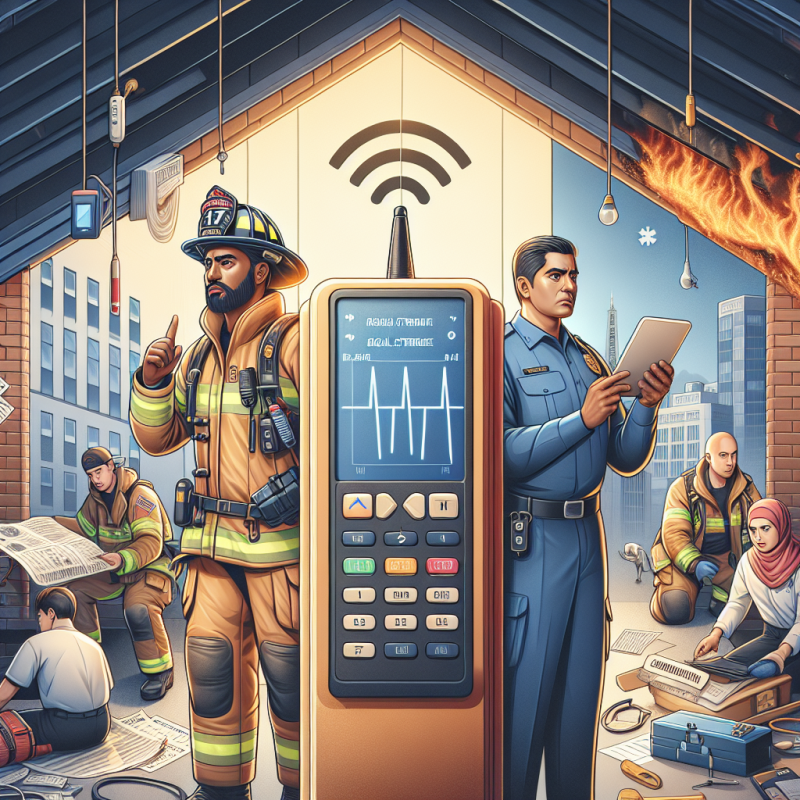
Imagine being inside a tall building when an emergency happens. Firefighters, police, or paramedics rush in. They need to talk to each other, but sometimes their radios don’t work well inside buildings. This is a big problem! That’s where ERRCS testing comes in.
ERRCS testing is a super important process that makes sure emergency responders can always talk on their radios, no matter where they are inside a building. It’s all about checking the signal strength of their radios. When we talk about signal strength, we often use a special number called RSSI. This blog post will tell you all about what ERRCS testing is and why it matters so much for everyone’s safety.
Table of Contents
- What is ERRCS Testing Anyway?
- Why Do We Measure Signal Strength?
- What Numbers Are We Looking For?
- Special Areas Need Extra Care: 99% Radio Communication Coverage
- Why is ERRCS Testing So Important?
- Frequently Asked Questions (FAQ)
What is ERRCS Testing Anyway?
ERRCS testing stands for Emergency Responder Radio Communication Systems testing. Think of it as a thorough check-up for a building’s special radio system. This system, often called a Public Safety Distributed Antenna System (DAS) or Bi-Directional Amplifier (BDA) system, is put in place to make sure that firefighters, police officers, and other emergency helpers can use their two-way radios to talk clearly, even in places where normal radio signals might not reach.
Buildings, especially big ones like hospitals, schools, offices, or shopping malls, can block radio signals. Walls, floors, and even the materials used to build them can act like giant shields, creating “dead spots” where radios don’t work. This is very dangerous during an emergency. If a firefighter can’t call for help or tell others where a fire is, it puts lives at risk.
The whole point of ERRCS testing is to find these dead spots and make sure they are fixed. It’s a way to prove that the building is safe for first responders. We use special tools to measure how strong the radio signals are in every part of the building. This measurement is called signal strength.
We don’t just guess; we use specific numbers to make sure the signal strength is good enough. If the signals are too weak, it means the emergency radios won’t work, and people’s lives could be in danger. So, ERRCS testing is about making sure these vital communication lines are strong and reliable throughout the entire building. It’s a critical part of a building’s overall safety plan.
Lexico helps building owners make sure their buildings are ready for emergencies by providing expert in-building wireless services, including BDA/ERRCS installation, testing, and maintenance. We understand the importance of clear communication for public safety.
Why Do We Measure Signal Strength?
Measuring signal strength is like checking how loud someone is talking. If they’re talking too quietly, you can’t hear them. It’s the same with radio signals. If the signal strength is too low, the radio won’t be able to send or receive messages clearly. This can lead to choppy conversations, dropped calls, or no communication at all.
For emergency responders, clear communication is not just nice to have; it’s absolutely essential. They need to be able to talk to each other and to their command center without any breaks or static. They might be giving important instructions, asking for help, or reporting on a dangerous situation. Every word counts, and every second matters.
We measure signal strength using a specific number called RSSI. RSSI stands for Received Signal Strength Indicator. It’s a technical term, but you can think of it simply as a number that tells us how strong the radio signal is at a certain spot.
RSSI is usually measured in decibel-milliwatts, or dBm. This might sound complicated, but here’s the easy part: these numbers are almost always negative. For example, you might see numbers like -50 dBm, -75 dBm, or -95 dBm.
Here’s the trick to understanding RSSI:
- The closer the number is to zero, the stronger the signal. So, -50 dBm is a much stronger signal than -95 dBm.
- A signal of -50 dBm is like someone shouting clearly.
- A signal of -95 dBm is like someone whispering from far away.
For emergency radios, we need a signal that’s loud enough to be heard clearly. That’s why ERRCS testing focuses so much on getting the RSSI numbers right. We need to make sure the signal is strong enough everywhere so that first responders can do their job safely and effectively. Without reliable signal strength, their radios are useless, and that means lives are at risk.
To ensure proper radio coverage and signal strength for first responders, Lexico offers expert public safety signal testing and reporting services.
What Numbers Are We Looking For?
During ERRCS testing, we don’t just look for any signal strength. We look for very specific numbers that tell us the radio communication system is working perfectly. These numbers are set by local fire codes and national standards to ensure the highest level of safety.
Think of it like a report card for the building’s radio system. We want to see passing grades in all categories. If any of these numbers are too low, it means the system isn’t good enough, and it needs to be fixed.
Let’s break down the main requirements:
95% of Areas with RSSI > -95dBm
This is one of the most important rules for ERRCS testing. It means that in almost every part of the building – at least 95 out of every 100 spots – the signal strength (our RSSI number) must be better than (or greater than) -95dBm.
- What does RSSI > -95dBm mean? It means the signal should be -95dBm or a number closer to zero, like -90 dBm, -85 dBm, or even -60 dBm. Remember, the closer to zero, the stronger the signal. So, -95dBm is generally the weakest acceptable signal in most areas. Any signal weaker than -95dBm (like -96dBm or -100dBm) is considered a “dead spot” where radios might not work.
- Why 95%? This percentage makes sure that nearly the entire building has strong enough radio coverage. It accounts for the vast majority of spaces where first responders might need to communicate. If only 70% of a building had good coverage, that leaves 30% where firefighters could be cut off, which is far too risky. ERRCS testing helps identify these areas of weak signal and ensures they are strengthened.
DAQ > 3.0
DAQ stands for Digital Audio Quality. This measurement tells us how clear the voices sound when someone is talking on the radio. It’s not just about hearing a sound; it’s about hearing clear sound.
- What does DAQ > 3.0 mean? A DAQ score of 3.0 is like hearing someone speak clearly without too much static or breaking up. A higher number is better. If the DAQ is too low (like 1.0 or 2.0), it means the voices might sound garbled, fuzzy, or cut in and out, making it very hard to understand important messages.
- Why is clear audio important? Imagine a firefighter trying to tell someone how to escape a smoky room, but their voice keeps breaking up. Or a police officer trying to get information about a dangerous situation, but they can’t understand the details. Clear audio ensures that every command, every warning, and every piece of information is understood perfectly, which is vital for quick and effective emergency response.
BER < 2.6%
BER stands for Bit Error Rate. This is a very technical term, but we can make it simple. Digital radio signals are made up of tiny pieces of information called “bits.” Think of these bits as tiny puzzle pieces that make up the whole picture (the sound of someone’s voice).
- What does BER < 2.6% mean? It means that less than 2.6% of these tiny information pieces can be lost or messed up. If too many bits are lost, the message gets scrambled, and you can’t understand what’s being said. A lower percentage is better because it means fewer errors.
- Why is a low BER important? If the BER is too high, it’s like trying to read a book where many words are missing. You might get the general idea, but you’ll miss important details. In emergency communication, missing details can be very dangerous. A low BER ensures that the radio messages are received accurately, without any distortion or missing parts.
SNR > 16dB
SNR stands for Signal-to-Noise Ratio. This measurement compares how strong the actual radio signal is to how much background noise there is. Think of it like trying to listen to someone talk in a noisy room. If the person is talking loudly and the room is quiet, it’s easy to hear them (high SNR). If the person is talking softly and the room is very noisy, it’s hard to hear them (low SNR).
- What does SNR > 16dB mean? It means that the useful radio signal must be much stronger than any unwanted background noise. A higher SNR number is better because it means the signal stands out clearly from the noise. If the SNR is too low, the radio might pick up static, buzzing, or other interference, making it hard to hear the actual voices.
- Why is a good SNR important? In emergency situations, buildings can be noisy places. Alarms might be blaring, machinery might be running, or there could be sounds of debris. First responders need to be able to hear their radios over all this noise. A good SNR ensures that the critical messages come through loud and clear, even in chaotic environments.
These specific requirements, including signal strength (RSSI), DAQ, BER, and SNR, are the backbone of proper ERRCS testing. They ensure that the emergency radio system in a building is not just “working,” but working at a level that guarantees the safety and effectiveness of emergency responders. Lexico’s thorough ERRCS testing procedures are designed to meet or exceed these critical benchmarks. You can learn more about code requirements for public safety DAS on our website.
Special Areas Need Extra Care: 99% Radio Communication Coverage
While 95% coverage might be good for most of a building, there are some very special and important spots where we need almost perfect radio coverage. These are called critical areas. For these specific places, the rules for ERRCS testing say we need 99% radio communication coverage. This means that in 99 out of every 100 spots in these areas, the radio signal must be strong and clear.
What are these critical areas? They are the places where first responders are most likely to go, especially during an emergency, and where clear communication is absolutely non-negotiable.
Here are the main critical areas:
- Stairwells: These are the paths firefighters and other emergency personnel use to go up and down a building, especially when elevators are not safe or available. They are also evacuation routes for building occupants. If radios don’t work in stairwells, responders could get lost, miss vital instructions, or not be able to call for help themselves. ERRCS testing focuses heavily on ensuring these crucial routes have flawless signal strength.
- Elevator Lobbies: These are the areas right outside elevators on each floor. First responders might use elevators (if safe) or need to communicate here before entering other parts of a floor. People evacuating might gather here, too. Clear radio communication in these lobbies is essential for coordinating actions and managing people.
- Exits and Entrance Points: These are the places where responders enter and leave the building. They need to be able to communicate with their teams outside and inside as they move through these points.
- Fire Command Centers: If a building has a special room where emergency efforts are managed, it absolutely needs perfect radio coverage. This is the brain of the emergency response inside the building.
- Other Key Areas: This might include mechanical rooms, electrical rooms, or other spaces where firefighters or other responders might need to go to manage utilities or equipment during an emergency.
Why is 99% radio communication coverage so important in these specific spots?
- Safety First: First responders often face dangerous situations. They rely on their radios for their own safety and the safety of those they are helping. Losing communication in a stairwell or elevator lobby could trap them or prevent them from getting critical information.
- Coordination: During an emergency, different teams need to work together. Clear radio communication in these critical areas ensures that everyone is on the same page, coordinating their actions, and making the best decisions.
- Life-Saving Information: Critical messages, like “fire on the third floor” or “person trapped in stairwell B,” must be heard without any doubt. These messages are often exchanged in these high-traffic, critical areas.
ERRCS testing makes sure that these critical areas are thoroughly checked, and if any signal strength issues or communication dead zones are found, they are fixed immediately. This extra level of detail in ERRCS testing for critical areas significantly boosts the safety of both emergency personnel and the people inside the building. It helps prevent communication failures that could lead to tragic outcomes.
Lexico specializes in ensuring first responder communication is robust in all areas, especially critical areas, through our comprehensive ERRCS testing and Public Safety DAS services. We are dedicated to making sure radio communication coverage meets the highest standards.
Why is ERRCS Testing So Important?
ERRCS testing isn’t just a suggestion; it’s a vital part of building safety and a strict requirement in many places. It’s about protecting lives and making sure that when an emergency strikes, the people who come to help can do their job effectively.
Here are the key reasons why ERRCS testing is so incredibly important:
Compliance with Local Fire Codes
One of the biggest reasons ERRCS testing is required is to meet local fire codes. These codes are a set of rules and laws created by your local government (like your city or county) to keep buildings safe from fire and other emergencies.
- Legal Requirement: Most new buildings, and many older ones undergoing big changes, are required by law to have an ERRCS in place and to regularly test it. This isn’t optional. If a building doesn’t pass its ERRCS testing, it might not get its occupancy permit, meaning people can’t live or work there.
- Fire Marshal Approval: The local fire marshal is the official in charge of fire safety. They are the ones who inspect buildings and make sure they follow all the rules. If a building fails its ERRCS testing, the fire marshal can issue fines, order the building to be shut down, or even stop construction until the problem is fixed.
- Avoiding Penalties: Not following fire codes can lead to big problems for building owners. This includes heavy fines, legal issues, and even problems with insurance if an incident occurs and the building wasn’t compliant. Regular ERRCS testing helps building owners avoid these costly penalties and ensures safety compliance. Lexico can help with ERRCS permit submittals to ensure all paperwork is in order.
Public Safety: Lives Depend On It
This is the most important reason of all. ERRCS testing directly saves lives.
- First Responder Safety: Firefighters, police officers, and paramedics often enter dangerous and unpredictable situations. They rely on their radios to communicate critical information:
- Where is the fire?
- Are there people trapped?
- Are hazardous materials present?
- Where is backup needed?
- What is the quickest escape route?
- Building Occupant Safety: Clear communication for first responders means they can find and help people inside the building more quickly and efficiently. If firefighters can communicate clearly, they can coordinate rescue efforts, guide people to safety, and put out fires faster, directly impacting the safety of everyone in the building.
- Effective Emergency Response: When an emergency happens, every second counts. Good radio coverage allows emergency teams to react faster, share information instantly, and make better decisions. This quick and effective response can mean the difference between a minor incident and a major disaster. ERRCS testing ensures that the vital communication infrastructure is always ready.
Ongoing Maintenance and Annual Testing
ERRCS testing isn’t a one-time thing. After a building’s ERRCS is installed and passes its initial tests, it needs to be maintained and tested regularly.
- Annual ERRCS Testing: Most fire codes require an annual check-up of the ERRCS. This annual testing makes sure the system is still working correctly. Buildings change over time – new walls might be added, equipment moved, or even just general wear and tear can affect signal strength. Regular testing catches these issues before they become dangerous.
- System Integrity: Just like you service your car to keep it running smoothly, an ERRCS needs regular checks. This prevents small problems from becoming big, expensive ones. ERRCS testing makes sure that all parts of the Public Safety DAS, including Bi-Directional Amplifiers (BDAs) and antennas, are functioning as they should.
- Reliability: The goal is a highly reliable emergency responder radio communication system. Routine ERRCS testing and maintenance ensure that building owners can be confident that their system will perform when it’s needed most, protecting occupants and emergency personnel. Lexico provides comprehensive solutions, from BDA/ERRCS installation to annual testing and maintenance, ensuring long-term system reliability. You can see how we handle grid testing and reporting for Public Safety DAS.
In summary, ERRCS testing is more than just checking boxes for a permit. It’s a fundamental part of a building’s public safety infrastructure, ensuring that first responders can communicate flawlessly during emergencies. This saves lives, prevents greater damage, and keeps building owners compliant with important fire codes.
If you’re a building owner, facility manager, or involved in new construction, understanding and prioritizing ERRCS testing is absolutely essential. It’s an investment in safety that pays off when it matters most.
Frequently Asked Questions (FAQ)
What is ERRCS Testing?
ERRCS testing (Emergency Responder Radio Communication Systems testing) is a crucial process to verify that a building’s in-building radio system provides reliable two-way radio communication for first responders like firefighters and police, especially in areas where normal radio signals might be blocked. It involves measuring signal strength and audio clarity to ensure there are no “dead spots.”
Why is ERRCS Testing Mandatory?
ERRCS testing is often a legal requirement mandated by local fire codes and national standards. It ensures public safety by guaranteeing that emergency responders can communicate effectively inside buildings during critical incidents, which is vital for their safety and the safety of building occupants. Non-compliance can lead to fines and legal issues.
What are the key metrics for ERRCS testing?
Key metrics include Received Signal Strength Indicator (RSSI), which must be above -95dBm in 95% of areas (and 99% in critical areas like stairwells and elevator lobbies). Other important measurements include Digital Audio Quality (DAQ) > 3.0, Bit Error Rate (BER) < 2.6%, and Signal-to-Noise Ratio (SNR) > 16dB, all ensuring clear and reliable communication.
How often should ERRCS testing be performed?
After initial installation and certification, most fire codes require annual ERRCS testing and ongoing maintenance. This ensures the system remains compliant and fully operational, accounting for any building modifications or system degradation over time.
How can Lexico help with ERRCS compliance?
Lexico offers comprehensive in-building wireless services, including BDA/ERRCS installation, ERRCS testing, and maintenance. We handle ERRCS permit submittals and ensure your building meets all local fire codes and industry standards, providing turn-key DAS solutions for first responder communication.
Get Your Building Ready for Any Emergency with Lexico
Making sure your building is safe for first responders and everyone inside is a top priority. ERRCS testing is the key to knowing that emergency radios will work when needed most, providing clear signal strength and reliable communication.
At Lexico, we are experts in in-building wireless services for public safety. We understand all the complex requirements, from RSSI numbers to DAQ, BER, and SNR, and the critical need for 99% radio communication coverage in vital areas like stairwells and elevator lobbies. We ensure your building meets and exceeds all local fire codes and standards.
Whether you need initial ERRCS testing for a new construction project, require annual testing and maintenance for an existing system, or need help with ERRCS permit submittals, our team is ready to help. We provide turn-key DAS solutions for first responder communication, ensuring seamless installation and ongoing compliance.
Don’t leave public safety to chance. A building that fails its ERRCS testing isn’t just out of compliance; it’s a building that puts lives at risk. Let Lexico ensure your building’s emergency radio communication system is strong, clear, and ready for any situation.
Contact Lexico today to discuss your ERRCS testing needs and learn how we can help you achieve full safety compliance and peace of mind. Your building’s safety, and the safety of those within it, is our mission.
Ensure Your Building's Safety - Contact Lexico Today