
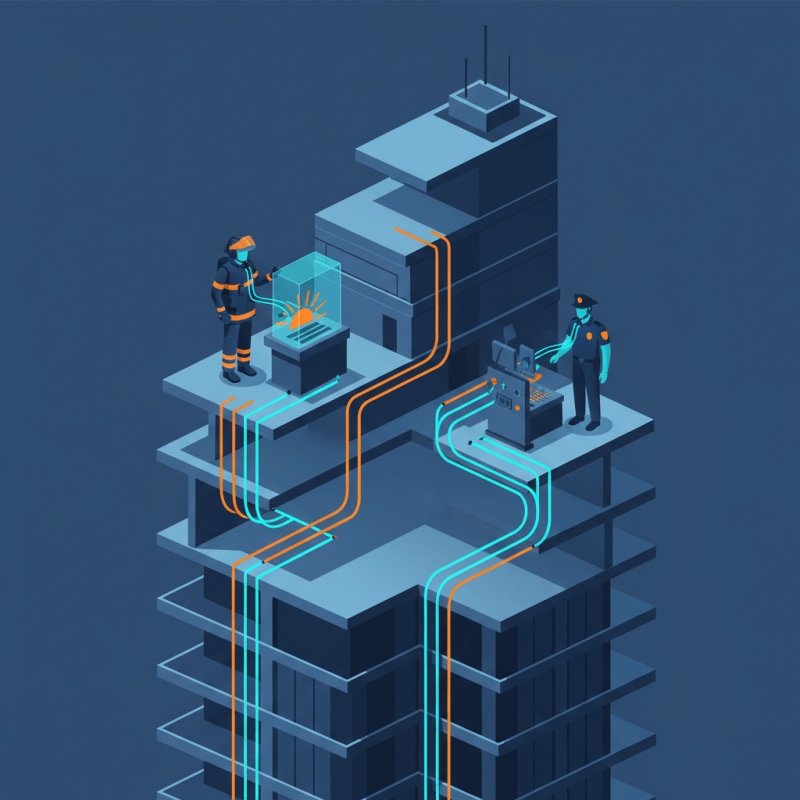
- The Life-Saving Significance of Building Code Compliance
- The Architecture of a High-Performing ERRCS System
- Guaranteeing Emergency Responder Radio Coverage With Qualified Experts
- Maintaining Your System Through Annual Testing and Recertification
- Frequently Asked Questions About Emergency Responder Radio Coverage
When a crisis strikes inside a commercial building, clear communication is the ultimate lifeline. First responders rush into complex structures to save lives, control fires, and neutralize medical emergencies. However, they frequently encounter a hidden, life-threatening danger known as a ‘dead zone’. These are isolated areas where thick concrete, metal framing, and modern building materials completely block their two-way radio signals.
To solve this dangerous problem, property owners must invest in specialized indoor signal technology. Reliable emergency responder radio coverage ensures that police, fire, and medical teams can speak to their dispatchers seamlessly. Without this continuous radio link, rescue operations slow down, coordination fails, and lives are put at serious risk. First responders cannot afford to lose contact with their commanders when navigating smoke-filled hallways or deep underground basements.
Modern building codes now strictly mandate the installation of specialized amplification equipment to fix this issue. Regulatory bodies understand that public safety relies on unbroken communication during critical events. Therefore, property developers and facility managers must install specific technology to bridge the gap between outdoor radio towers and indoor environments. This is not merely a strong recommendation; it is a strict legal requirement enforced by local fire marshals.
Navigating these rigorous safety regulations can feel overwhelming for building owners and construction managers. Understanding the specific codes, selecting the right equipment, and passing local inspections requires a deep level of technical expertise. This comprehensive guide will explain the vital importance of adhering to these safety standards. We will explore how modern communication systems work, why expert installation is non-negotiable, and how ongoing maintenance keeps your property completely compliant.
The Life-Saving Significance of Building Code Compliance
The foundation of any safe commercial structure lies in strict building code compliance. Local governments adopt national fire and safety codes to protect occupants and first responders alike. The most prominent standards governing indoor communications are created by the National Fire Protection Association (NFPA) and the International Code Council (ICC). Specifically, NFPA 1225 and Section 510 of the International Fire Code (IFC) dictate exactly how indoor radio systems must perform.
These rigorous regulations exist because modern construction techniques severely hinder radio frequency (RF) signals. Energy-efficient building materials, such as Low-E glass windows and thick structural steel, act as a massive shield against outside radio waves. While these materials drastically lower heating and cooling costs, they effectively block public safety radio frequencies from entering the building. Building codes exist to mandate technological workarounds for this exact modern problem.
Failing to achieve strict building code compliance carries severe consequences for property owners and developers. If a newly constructed building does not pass its initial radio signal test, the local fire marshal will not issue a Certificate of Occupancy (CO). Without a CO, building owners cannot legally move tenants in, open their business, or start generating revenue. A failed radio inspection can delay a multi-million dollar real estate project for months.
Furthermore, the legal liability of ignoring these codes is monumental. If an emergency occurs and first responders cannot communicate due to a non-compliant building, the property owner could face devastating lawsuits. Ensuring compliance is not just about checking a box for a local inspector. It is about actively taking responsibility for the lives of the men and women who rush into danger to protect your property.
Local authorities enforce specific signal strength metrics to guarantee flawless performance. The IFC generally requires a minimum signal strength of -95 decibel-milliwatts (dBm) across 90 percent of general building areas. More importantly, critical areas like stairwells, elevator lobbies, and fire pump rooms must maintain that signal strength across 99 percent of their square footage. Achieving these precise numbers requires advanced technology and professional engineering.
The Architecture of a High-Performing ERRCS System
To overcome the barrier of modern building materials, properties require an Emergency Responder Radio Communication System. An ERRCS system acts as a massive, localized megaphone for public safety radio signals. It captures weak signals from distant city radio towers, cleans up the frequency, and amplifies it evenly throughout the interior of the building. This creates a robust, localized network dedicated entirely to first responders.
At the very core of this technology is the Bi-Directional Amplifier, commonly referred to as a BDA. The BDA serves as the powerful brain of the entire network. It pushes signals inward to the responders inside the building and pulls their transmission signals outward back to the dispatch center. These highly sophisticated amplifiers must be carefully tuned to specific public safety frequencies to avoid interfering with commercial cellular networks.
An ERRCS system relies on a network of strategically placed components to distribute these amplified signals. A ‘donor antenna’ is securely mounted on the roof of the building, pointed directly at the nearest emergency radio tower. This antenna catches the initial RF signal and sends it down through heavy-duty coaxial cables into the BDA. The BDA then pushes the boosted signal into a Public Safety Distributed Antenna System (DAS).
The DAS is a carefully engineered web of cables, splitters, and indoor antennas hidden throughout the building’s ceilings. These indoor antennas broadcast the life-saving radio coverage into basements, parking garages, and interior hallways. Designing this web requires meticulous planning to ensure the radio waves reach every single isolated corner of the facility. Engineers must account for walls, doors, and elevator shafts that might deflect the radio waves.
Validating the performance of this equipment requires a highly specialized procedure known as grid testing. Technicians divide the floor plan of the building into a grid of 20 equal squares. They then walk through each individual square with an advanced spectrum analyzer, measuring the exact strength of the radio signal. If more than two squares fail to meet the required -95 dBm threshold, the entire floor fails the inspection, and the system must be recalibrated.
Guaranteeing Emergency Responder Radio Coverage With Qualified Experts
Installing these complex amplification networks is never a do-it-yourself project or a job for a standard IT contractor. Providing reliable emergency responder radio coverage requires a profound understanding of radio frequency engineering and local municipal laws. The Federal Communications Commission (FCC) strictly regulates who can install and operate these powerful radio boosters. Only highly certified professionals possess the legal authority and technical knowledge to perform this critical work.
When an inexperienced contractor attempts to install a public safety BDA, the results can be catastrophic. If the system is not perfectly balanced, it can create a dangerous feedback loop known as ‘oscillation’. This is similar to the loud screeching noise you hear when a microphone gets too close to a speaker. In the world of radio frequencies, this oscillation can shoot back out of the building and completely disable the city’s main emergency radio tower.
To prevent city-wide communication blackouts, local fire departments require integration partners to hold specific credentials. Technicians generally must possess a General Radiotelephone Operator License (GROL) issued by the FCC. Additionally, they must hold factory certifications from top-tier equipment manufacturers like Nextivity, Fiplex, Comba, or ADRF. These credentials prove that the technician understands the intricate software and hardware of the amplifiers.
Qualified experts utilize highly advanced predictive modeling software long before a single cable is pulled. Using industry-standard programs like iBwave, engineers import the building’s architectural blueprints and digitally map the internal structures. The software simulates exactly how radio waves will bounce off concrete pillars and travel down long corridors. This 3D heat-mapping ensures the design is perfectly optimized, saving the building owner from costly hardware modifications later.
Furthermore, elite service providers manage the complex bureaucratic process of municipal approvals. They handle the submission of shop drawings, secure the necessary electrical permits, and coordinate the final walk-through with the Authority Having Jurisdiction (AHJ). A seasoned provider acts as a dedicated liaison between the building owner and the local fire marshal. This expertly guided approach guarantees that the project moves swiftly and achieves full certification without unnecessary delays.
Maintaining Your System Through Annual Testing and Recertification
Achieving initial compliance is merely the first step in protecting your building and its occupants. The components that power these critical communication networks degrade over time, and the physical environment around the building constantly changes. Because of this, fire codes mandate strict ongoing maintenance protocols. Annual Testing and Recertification, known in the industry as ATR, is absolutely vital for maintaining system integrity.
An annual inspection ensures that your equipment operates flawlessly when an actual emergency occurs. During an ATR, licensed technicians physically inspect the BDA, the donor antenna on the roof, and the indoor DAS network. They sweep the entire building with specialized scanning equipment to verify that the radio signal strength still meets the legal threshold. They also check for any new dead zones that might have appeared due to internal office renovations.
The external radio environment is constantly shifting, which can severely impact your internal coverage. A new high-rise building constructed across the street can easily block the signal path between your roof antenna and the city radio tower. Additionally, local fire departments frequently update their radio frequencies or migrate to new digital radio systems. Annual testing allows technicians to reprogram your BDA to ensure it remains perfectly synchronized with the local dispatcher.
Battery backup systems are a major focal point during the annual recertification process. Because emergencies often involve total power grid failures, public safety radio systems must run on dedicated emergency power. Fire codes dictate that the BDA battery backup must provide 12 to 24 hours of uninterrupted power. Technicians perform rigorous load testing on these heavy-duty batteries to ensure they will not fail when the building goes dark.
Finally, technicians thoroughly inspect the automated alarm functions of the amplification system. Modern public safety networks are required to monitor themselves and alert the building’s main fire alarm panel if something goes wrong. Technicians verify that alarms for AC power failure, low battery voltage, and antenna malfunctions are triggering correctly. Submitting the passing results of this comprehensive annual test to the local fire marshal protects the building owner from fines and ensures continuous legal compliance.
Frequently Asked Questions About Emergency Responder Radio Coverage
What exactly is an ERRCS system?
An Emergency Responder Radio Communication System is a specialized network of antennas, cables, and amplifiers installed inside a commercial building. It captures weak emergency radio signals from outside, amplifies them, and broadcasts them internally. This ensures that police, fire, and EMS personnel can communicate using their two-way radios in areas like basements, stairwells, and elevator lobbies where signals typically fail.
Why is building code compliance mandatory for new constructions?
Building codes require these communication networks because modern construction materials like thick concrete, steel, and energy-efficient glass block radio frequency waves. If first responders cannot talk to their commanders while inside a building, rescue operations become incredibly dangerous. Local fire marshals enforce these codes strictly; buildings that fail to provide adequate radio coverage will be denied a Certificate of Occupancy.
How often does emergency responder radio coverage need testing?
Fire codes, specifically guidelines established by the NFPA and the IFC, mandate that public safety radio systems undergo comprehensive testing at least once a year. This Annual Testing and Recertification (ATR) involves checking signal strength, verifying battery backup capacity, and ensuring the system does not interfere with the city’s main radio towers. Regular testing ensures the system will perform flawlessly during an actual crisis.
What causes poor radio signals inside a building?
Radio signals are easily degraded or completely blocked by dense physical barriers. Underground parking garages, concrete stairwells, and rooms surrounded by structural steel are notorious for creating communication dead zones. Furthermore, the Low-E coated glass used in modern environmentally friendly buildings acts as a massive shield that reflects radio waves away from the structure.
Can any electrician install a public safety radio system?
No, installing public safety radio equipment requires highly specialized knowledge and credentials. Standard electricians do not possess the radio frequency engineering expertise or the mandatory FCC licenses required to commission these powerful amplifiers. Incorrect installation can cause massive feedback loops that disable local emergency dispatcher towers, making qualified RF technicians absolutely necessary.
Ensuring your property adheres to strict safety regulations is a complex but vital responsibility. Faulty or non-existent radio coverage puts the lives of heroic first responders and your building occupants in grave danger. Do not risk devastating legal liability, massive fines, or delayed building openings by ignoring these critical mandates. If you are developing a new property, managing an existing structure, or facing an upcoming annual fire inspection, you need a trusted partner. Reach out to our dedicated team of certified engineers at Lexico today to schedule a comprehensive signal benchmark test and expert consultation.
Ensure Your Building's Safety - Contact Lexico Today