
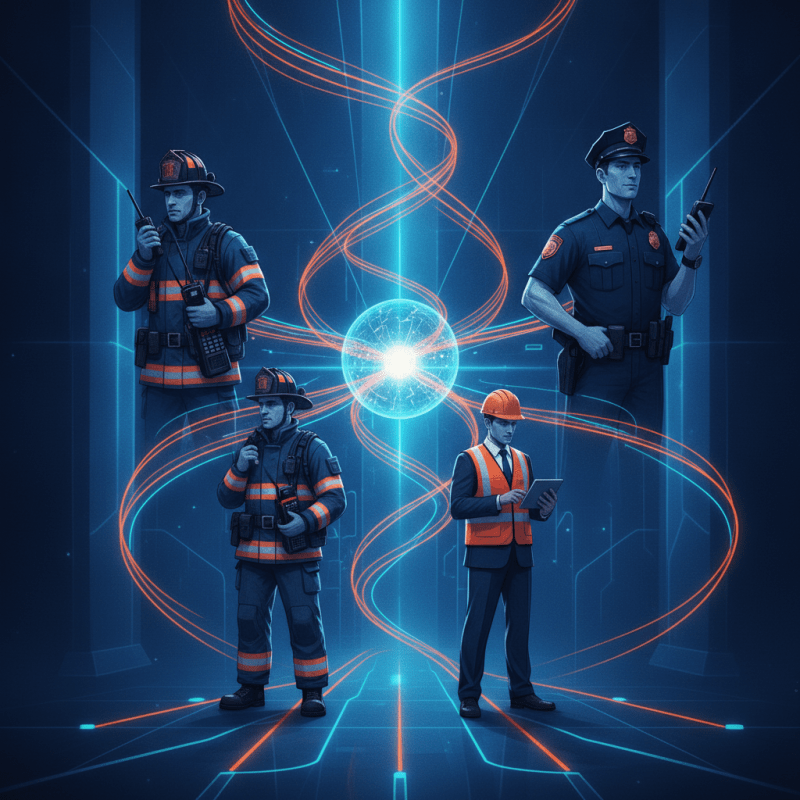
Modern buildings are constructed with highly energy-efficient materials like low-E glass and dense concrete. These materials are great for the environment but terrible for radio frequency signals. They block both everyday cell phone signals and critical emergency radios from reaching inside. This creates a massive problem for property owners who must provide strong internal connectivity.
Building owners must now support two entirely different wireless ecosystems under one roof. They must provide robust commercial cellular services for tenants, employees, and visitors. They must also guarantee flawless public safety communications for emergency responders like firefighters and police. Achieving this delicate balance requires specialized technology and careful planning.
A Distributed Antenna System (DAS) is the ultimate solution to this modern connectivity challenge. A DAS can capture weak outside signals and distribute them evenly throughout a large structure. However, designing a single system to handle both commercial and emergency traffic is complex. It requires specialized engineering to ensure neither system interferes with the other.
This post explores how to balance public safety communications and commercial cellular services within a single wireless infrastructure. We will cover the technical design challenges and the strict regulatory requirements involved. Finally, we will explain how expert integration ensures your building remains both connected and compliant.
- Balancing Public Safety Communications and Commercial Needs in a Distributed Antenna System (DAS)
- Ensuring Reliability, Coverage, and Interoperability in Public Safety Communications
- Meeting the Demand for High-Speed Commercial Cellular Services
- Balancing Frequency Allocation and Coverage Prioritization in DAS Design
- The Role of Dual-Mode Antennas, Repeaters, and Dynamic Resource Allocation
- Regulatory Compliance and Carrier Partnerships in DAS Deployment
- Frequently Asked Questions About Distributed Antenna System (DAS) Solutions
Balancing Public Safety Communications and Commercial Needs in a Distributed Antenna System (DAS)
Property developers face a unique challenge when designing modern building infrastructure. They must accommodate the daily data needs of hundreds of occupants while maintaining a critical lifeline for first responders. Combining these requirements into a single Distributed Antenna System (DAS) offers an elegant, space-saving solution. However, converging these two distinct networks requires precise engineering and a deep understanding of radio frequency behavior.
A converged network infrastructure saves property owners significant money on equipment and installation costs. Instead of pulling two completely separate sets of coaxial or fiber optic cables, building owners can utilize a shared physical backbone. This shared approach minimizes disruption during installation and reduces the amount of space needed in crowded telecom closets. Despite these financial benefits, combining networks introduces the risk of signal interference if not managed correctly.
Commercial cellular services and public safety communications operate on different frequency bands and have vastly different operational goals. Commercial networks prioritize high bandwidth and fast data speeds to handle video streaming and internet browsing. In contrast, emergency responder radio communication systems focus purely on mission-critical voice clarity and absolute reliability. When these systems share a physical DAS, engineers must guarantee that commercial traffic never overwhelms the emergency channels.
Balancing these needs starts with a comprehensive site survey and professional signal benchmark testing. Engineers measure existing signal strength across all required frequencies before designing the system. They map out internal dead zones, identify potential sources of interference, and determine the exact requirements for signal amplification. This vital data forms the foundation of a highly customized, effective wireless solution.
Professional system designers use advanced software like iBwave to model the environment and simulate signal propagation. This allows them to virtually test different antenna placements and equipment configurations before any physical construction begins. Proper planning ensures that the final design provides balanced, reliable coverage for both everyday users and emergency personnel. A poorly planned converged network can lead to dropped calls for tenants and life-threatening dead zones for firefighters.
Ultimately, the goal of a unified Distributed Antenna System (DAS) is harmonious operation. Tenants should enjoy seamless internet downloads while building owners rest easy knowing they are fully compliant with local fire codes. Achieving this peace of mind requires partnering with skilled integrators who specialize in complex radio frequency environments.
Ensuring Reliability, Coverage, and Interoperability in Public Safety Communications
When an emergency occurs inside a large commercial building, reliable communication can mean the difference between life and death. Firefighters, police officers, and paramedics rely entirely on their two-way radios to coordinate rescues and call for backup. Public safety communications cannot fail, experience static, or drop out in critical areas like stairwells or deep basements. Ensuring this absolute, unwavering reliability is the primary function of an Emergency Responder Radio Communication System.
First responders use specific radio frequencies allocated by the government, typically within the 700 MHz and 800 MHz bands. These Ultra High Frequency and Very High Frequency bands penetrate structural walls differently than standard commercial cellular signals. To ensure these signals reach every corner of a building, engineers utilize specialized Bi-Directional Amplifiers. These amplifiers capture the weak signal from the outdoor donor tower, boost it significantly, and push it through the internal building network.
Coverage requirements for emergency networks are incredibly strict and heavily regulated by local fire and building codes. Standards like the National Fire Protection Association code 1225 mandate near-perfect coverage in critical, high-risk areas. For example, emergency command centers, fire pump rooms, and exit stairwells typically require 99 percent signal coverage. General building areas usually require at least 95 percent coverage to pass rigorous fire marshal inspections.
Interoperability is another crucial factor in emergency radio system design and deployment. Different public safety agencies often use slightly different radio technologies or operate on distinct frequency sub-bands. A modern emergency responder system must be capable of amplifying all necessary local frequencies simultaneously. This ensures that a responding police unit can communicate just as effectively as the fire department team already inside the structure.
To guarantee reliability during a crisis, emergency communication systems must have dedicated, robust backup power supplies. Building codes require these systems to remain fully operational for up to 24 hours during a total grid power outage. This requires installing dedicated battery backup units stored in specialized, fire-rated NEMA enclosures. These protective enclosures shield the sensitive amplifying equipment from water, dust, and extreme heat during an active fire event.
Regular grid testing and continuous professional maintenance are required to keep these systems operating at peak performance. An annual inspection ensures that new building construction nearby has not disrupted the outdoor signal source. It also verifies that the internal backup batteries are fully charged and ready to deploy at a moment’s notice. Without meticulous upkeep, even the best-designed public safety network can fail when it is needed most.
Meeting the Demand for High-Speed Commercial Cellular Services
While emergency networks focus strictly on life safety, commercial cellular networks focus on lifestyle, productivity, and modern business operations. Tenants, corporate employees, and visitors expect their smartphones to work flawlessly from the moment they enter a building’s lobby. They demand fast, reliable data speeds for video conferencing, large file transfers, and uninterrupted social media access. Providing high-quality commercial cellular services is no longer a luxury; it is a fundamental expectation for all modern real estate.
To meet this immense, growing demand for data, cellular carriers utilize multiple frequency bands, including the latest 5G spectrums. 5G networks offer incredible download speeds, but their higher-frequency signals have extreme difficulty penetrating solid building materials. Dense concrete, heavy steel framing, and energy-efficient window coatings easily block these high-speed signals from reaching indoors. This makes an internal signal distribution system absolutely mandatory for large commercial spaces and office buildings.
A commercial Distributed Antenna System solves this problem by bringing the outdoor carrier network directly inside the building. Engineers install a network of small, discreet antennas hidden in drop ceilings or mounted cleanly on walls. These antennas broadcast the signals from major wireless carriers directly to the users wandering the halls and private offices. This creates a completely seamless transition for users moving from the outdoor macro network to the indoor environment.
One of the biggest challenges in commercial network design is managing dense user capacity. A busy sports arena or a towering high-rise office building during peak hours generates massive amounts of simultaneous network traffic. The internal network must be scaled appropriately to handle this heavy concentration of mobile devices without slowing down. If the system is under-designed, users will experience agonizingly slow data speeds and frequently dropped phone calls.
Modern commercial systems must also be carrier-agnostic, meaning they support all major wireless providers at the exact same time. A tenant using one major carrier expects the exact same quality of service as a visitor using a competing network. Designing a neutral-host network requires careful coordination to balance the specific signal requirements of each individual provider. This ensures a uniform, high-quality wireless experience for everyone inside the facility, regardless of their phone plan.
Investing in strong commercial connectivity significantly increases a property’s overall market value and long-term tenant retention rates. Businesses simply cannot operate efficiently in buildings plagued by frustrating cellular dead zones. By providing a robust indoor cellular network, property owners create a highly desirable, future-proofed commercial environment.
Balancing Frequency Allocation and Coverage Prioritization in DAS Design
Designing a converged wireless network is akin to managing a complex multi-lane highway for invisible radio waves. Engineers must carefully allocate different frequency lanes to prevent traffic jams between commercial data and emergency radio signals. Frequency allocation is a highly technical process that dictates how the Bi-Directional Amplifiers process incoming and outgoing transmissions. Proper allocation ensures that high-volume cellular data never drowns out a critical, life-saving voice transmission from a firefighter.
In a shared infrastructure, engineers must implement strict electronic filtering and signal isolation protocols. Filters act as digital bouncers, allowing only designated frequencies to pass through certain parts of the network architecture. These specialized components prevent the powerful commercial cellular signals from bleeding over into the sensitive public safety channels. Without high-quality filtering, a dangerous concept known as ‘noise floor elevation’ can completely disable an emergency responder radio.
Coverage prioritization is another vital aspect of planning a unified, highly effective internal network. Commercial users typically need the strongest signal coverage in open office spaces, large conference rooms, and building cafeterias. Conversely, emergency responders require maximum signal strength in concrete stairwells, elevator shafts, and subterranean utility rooms. A well-designed infrastructure routes the appropriate signal strength to the specific locations where each group needs it most.
To achieve this precise signal routing, system designers use complex modeling software to map the building’s radio frequency footprint. They account for the specific signal loss caused by internal drywall, thick fire doors, and various unique building materials. By analyzing this data, engineers can place directional antennas that focus public safety coverage precisely down a concrete stairwell. Meanwhile, omnidirectional antennas can be safely deployed to blanket an open-plan office with high-speed cellular data.
Managing the overall power output of the active amplifying equipment is critical to maintaining this delicate internal balance. If the commercial cellular amplifiers are set too high, they can inadvertently interfere with nearby outdoor macro cell towers. This creates severe network instability for users outside the building and can trigger hefty fines from the Federal Communications Commission. Expert integrators constantly monitor and adjust power levels during the system commissioning phase to guarantee perfect harmony.
Balancing frequencies and prioritizing coverage requires a deep mastery of advanced radio frequency engineering principles. It is not a matter of simply plugging in an amplifier and running a few cables down a hallway. It requires meticulous calibration, rigorous benchmark testing, and a thorough understanding of how different wireless networks interact.
The Role of Dual-Mode Antennas, Repeaters, and Dynamic Resource Allocation
Technology manufacturers have developed specialized hardware to support the convergence of public safety communications and commercial cellular services. Dual-mode antennas are among the most critical components deployed in these unified building networks. These advanced antennas are specifically engineered to broadcast both commercial frequencies and emergency radio bands at the same time. By utilizing dual-mode technology, integrators can drastically reduce the total number of physical antennas required inside a facility.
Using fewer antennas provides several distinct advantages for property owners and facility managers during installation. It lowers hardware costs, reduces installation labor hours, and creates a much cleaner aesthetic on the building’s ceiling. However, dual-mode antennas must be meticulously manufactured to ensure complete internal isolation between the disparate frequency bands. High-quality components from leading manufacturers prevent the signals from mixing and causing harmful interference at the broadcast point.
Repeaters, specifically highly engineered Bi-Directional Amplifiers, serve as the powerful engines driving these indoor wireless networks. In a converged environment, engineers often install separate repeaters for public safety and commercial bands that feed into the same cable backbone. The public safety repeater must meet strict fire code standards, including specialized NEMA enclosures and dedicated battery backups. The commercial repeater, while highly sophisticated for data processing, generally does not require the same extreme survivability ratings.
Dynamic resource allocation is an emerging concept that further enhances the efficiency of modern indoor cellular networks. Advanced digital systems can monitor network traffic in real-time and automatically adjust internal power distribution accordingly. For example, during a massive localized emergency, advanced systems could theoretically prioritize maximum signal strength strictly for first responder channels. While still evolving, this dynamic approach represents the future of highly adaptive, intelligent building infrastructure.
Active Distributed Antenna Systems utilize long runs of fiber optic cables to transport signals across massive sprawling campuses or towering high-rises. Fiber optic technology ensures that signal strength does not degrade over long distances, unlike traditional coaxial copper cables. The central hub converts the radio frequency signals into light, sends them over the fiber, and converts them back at remote units. This advanced method is incredibly effective for delivering clean, balanced signals to both dual-mode antennas and specialized single-band nodes.
Selecting the right combination of antennas, repeaters, and advanced cabling is a complex engineering puzzle. The chosen hardware must perfectly match the specific architectural layout and overall connectivity goals of the building. Working with a seasoned integration team guarantees that only the most reliable, high-performance equipment is deployed on your property.
Regulatory Compliance and Carrier Partnerships in DAS Deployment
Installing a signal enhancement system is not just a technical challenge; it is a complex legal and regulatory process. Both public safety communications and commercial cellular services are strictly governed by federal, state, and local regulatory laws. Navigating this bureaucratic landscape is just as important as the physical installation of cables and ceiling antennas. Failure to secure the proper permits and approvals can result in halted construction, severe fines, and legally non-viable systems.
For emergency responder networks, the local Authority Having Jurisdiction holds the ultimate approval power over the installation. The Authority Having Jurisdiction, usually the local fire marshal, enforces the specific National Fire Protection Association and International Fire Code standards. They dictate exactly which frequencies must be amplified, the required signal strength, and the mandatory duration of battery backup. System integrators must submit detailed design plans and testing documentation to the fire marshal to secure a building’s certificate of occupancy.
Commercial cellular deployments require a completely different, yet equally rigorous, approval process known as carrier coordination. Radio frequency spectrum is heavily regulated by the Federal Communications Commission, and carriers spend billions purchasing the rights to use it. You cannot simply install a commercial signal booster and begin broadcasting a major carrier’s signal without their explicit, written permission. Doing so is a federal offense because rogue, uncalibrated amplifiers can severely damage the carrier’s broader outdoor network.
Securing formal rebroadcast agreements from major wireless carriers requires demonstrating extreme technical competence and careful planning. Carriers will heavily scrutinize the proposed system design to ensure it includes proper filtering and will not cause noise floor interference. They require proof that the system will seamlessly hand off active calls as users walk in and out of the building. Professional integrators have established relationships with these carriers, allowing them to expedite this incredibly tedious, complex legal process.
The testing and commissioning phase represents the final hurdle in achieving full regulatory compliance for both systems. Integrators must perform exhaustive grid testing to prove to the fire marshal that emergency coverage meets the exact legal requirements. Simultaneously, they must provide detailed data logs to the cellular carriers proving the commercial network is operating within approved parameters. This dual-verification process is essential for turning a newly installed system into a fully operational, legal network.
Maintaining strict compliance is an ongoing responsibility that lasts for the lifetime of the building’s infrastructure. Fire codes require annual recertification of emergency communication systems to ensure continuous operational readiness. Property owners must partner with reliable maintenance providers to conduct these yearly inspections and keep their life-saving systems fully compliant.
Frequently Asked Questions About Distributed Antenna System (DAS) Solutions
Can public safety and commercial cellular services share the exact same amplifier?
Generally, it is not recommended and often not permitted by local fire codes to use the exact same amplifier for both networks. Public safety systems require specialized, fire-rated Bi-Directional Amplifiers with distinct battery backups and extreme survivability standards. Commercial systems use different amplifiers specifically designed for high data capacity. However, they can seamlessly share the same passive infrastructure, such as coaxial cables and dual-mode antennas, to save space and installation costs.
What is the primary difference between a public safety DAS and a commercial cellular DAS?
The primary difference lies in their core purpose and the strict regulatory requirements governing them. A public safety system is legally mandated by fire codes to ensure 100 percent reliable voice communication for emergency responders during a crisis. A commercial system is voluntarily installed by the property owner to provide everyday high-speed data and voice coverage for tenants. Emergency systems prioritize absolute reliability and backup power, while commercial systems prioritize fast data speeds and massive user capacity.
Why do my tenants have poor cell service in our newly constructed building?
New buildings are highly energy-efficient, utilizing heavy materials like low-E glass, dense concrete, and thick steel framing. These green building materials act as an incredible barrier, reflecting and blocking outdoor radio frequency signals from penetrating the walls. A commercial signal enhancement system captures the signal from outside and distributes it internally, bypassing these structural barriers entirely.
Do I need permission from cellular carriers to install a commercial DAS?
Yes, you absolutely must obtain formal rebroadcast agreements from the wireless carriers before turning on a commercial network. The Federal Communications Commission heavily regulates frequency spectrums, and broadcasting a carrier’s signal without permission is highly illegal. Professional system integrators handle this complex carrier coordination process to ensure your system is fully approved, legal, and functional.
How often does an Emergency Responder Radio Communication System need to be tested?
Most local fire codes, guided by strict National Fire Protection Association standards, require thorough testing and inspection of the system at least once a year. This annual inspection verifies that the battery backup is functioning, the alarms are communicating with the fire panel, and the signal strength remains adequate. Regular testing ensures the system will perform flawlessly when first responders need it most during a critical emergency.
Ensuring your building is both code-compliant and fully connected is a complex, high-stakes responsibility. Balancing the life-saving requirements of public safety communications with the high-speed demands of commercial cellular services requires unparalleled technical expertise. At Lexico, our specialized team manages every aspect of your emergency and commercial wireless systems, from initial signal benchmark testing to full-scale deployment and annual maintenance. Do not leave your building’s critical connectivity or strict legal compliance to chance. Contact Lexico today to request a comprehensive consultation and discover how our expert integrators can perfectly balance your internal wireless infrastructure.
Ensure Your Building's Safety - Contact Lexico Today