
- Understanding the Function of Public Safety DAS Antennas
- Selecting the Right Donor Antenna for Your ERCES
- Choosing the Best Service or Distribution ERCES Antenna Types
- Critical Factors for ERCES Antenna Installation
- The Importance of Professional BDA Antenna Installation
- Frequently Asked Questions About ERCES Antennas
During an emergency, clear and instant communication is a lifeline for first responders. Firefighters, police, and paramedics rely on their two-way radios to coordinate their efforts and call for backup. But what happens when building materials like concrete, steel, and low-e glass block their radio signals? The lifeline is cut, putting both emergency personnel and building occupants at severe risk. This is why having a fully functional Emergency Responder Radio Communication System (ERCES) is not just a good idea; it’s a legal requirement in many areas. A critical, yet often misunderstood, component of this life-saving system is its network of ERCES antennas.
Choosing the correct antennas and placing them properly is the difference between a system that passes inspection and one that performs flawlessly when lives are on the line. These devices are the vital link, capturing outside signals and distributing them throughout your property. This guide will walk you through the essential types of ERCES antennas, the key factors that influence their selection, and why professional installation is absolutely necessary to ensure the safety and compliance of your building.
Understanding the Function of Public Safety DAS Antennas
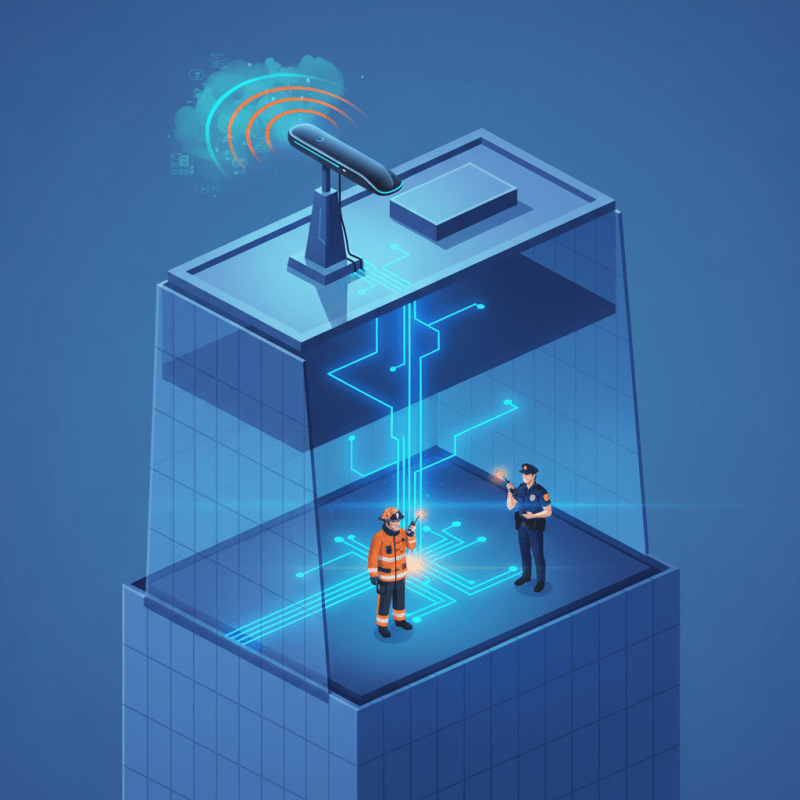
At its core, an ERCES, also known as a Public Safety Distributed Antenna System (DAS), is a signal booster for first responders. It takes a weak radio signal from outside, amplifies it using a Bi-Directional Amplifier (BDA), and then rebroadcasts it inside the building. This process also works in reverse, allowing a firefighter in a basement to transmit a clear signal out to the command center. The antennas are the unsung heroes of this entire operation.
Think of the system like a powerful public address system. The BDA is the amplifier, but without a microphone to capture sound and speakers to project it, the amplifier is useless. In an ERCES, antennas perform both of these roles. They are the ‘microphones’ that listen for signals from the public safety network and the ‘speakers’ that broadcast that signal clearly inside your building, ensuring no dead zones exist.
These critical components are divided into two primary categories. The first is the donor antenna, which communicates with the outside world. The second category is the service or distribution antenna, which handles signal coverage inside the property. Both must be selected and placed with expert precision for the system to function correctly.
Selecting the Right Donor Antenna for Your ERCES
The donor antenna is the system’s crucial connection to the nearest public safety radio tower. Its job is to capture the ‘off-air’ signal with enough strength and clarity for the BDA to amplify effectively. If the donor antenna fails to capture a clean, strong signal, the entire system’s performance will suffer, regardless of how powerful the amplifier is. It must be mounted on the roof or side of the building with the best available line of sight to the tower.
Choosing the right donor antenna depends heavily on your building’s location and the surrounding environment. An expert radio frequency (RF) survey is the first step in this process, as it identifies the direction and strength of the required signals. Based on this data, a professional will recommend one of three main types of donor antennas for your Public Safety DAS.
Yagi Antennas
Yagi antennas are highly directional, meaning they are designed to pull in signals from a single, specific direction. They look somewhat like a classic rooftop TV antenna with multiple cross-sections on a central boom. This focused design gives them very high ‘gain,’ which is the ability to increase the power of a signal in a particular direction. This makes Yagi antennas an excellent choice for buildings in rural or suburban areas where the public safety tower is far away but a clear line of sight exists. They can pinpoint the distant signal and pull it in effectively, ignoring potential interference from other directions.
However, this directional nature is also their main limitation. If the line of sight to the tower is obstructed or if strong signals come from multiple towers in different directions, a Yagi antenna may not be the best solution. Proper aiming is absolutely critical, as even a slight misalignment can result in a significantly degraded signal. A professional installer uses specialized equipment to lock onto the precise signal source for optimal performance.
Panel Antennas
Panel antennas are also directional, but they offer a wider beamwidth compared to Yagi antennas. This means they can capture signals from a broader area, making them more forgiving in their placement and alignment. Panel antennas are flat and rectangular, giving them a lower profile that is often preferred in urban and dense suburban settings where aesthetics are a concern. They provide good gain and are effective at rejecting unwanted signals from the sides and rear, which helps reduce interference.
These antennas are a versatile solution for many buildings. They work well when the public safety tower is relatively close but not in a perfect, unobstructed line. Their ability to cover a wider directional path makes them ideal for capturing signals that might be reflecting off adjacent buildings, a common scenario in city environments. They provide a strong balance of performance, placement flexibility, and visual appeal.
Omnidirectional Antennas
As their name suggests, omnidirectional antennas are designed to capture signals from all directions in a 360-degree pattern. These antennas are typically long, vertical rods. They are best suited for situations where strong, reliable public safety signals are available from multiple towers in different directions around the building. In such a scenario, a directional antenna might focus on one tower while missing a stronger signal coming from another.
The primary advantage of an omnidirectional antenna is the ease of installation, as it doesn’t require precise aiming. However, its main drawback is lower gain compared to directional antennas. Because it pulls signals from everywhere, it also pulls in more background RF ‘noise’ and potential interference, which can degrade the quality of the signal sent to the BDA. These are generally used only when an RF survey confirms strong signals from multiple sources and a directional antenna is impractical.
Choosing the Best Service or Distribution ERCES Antenna Types
Once the donor antenna has captured a clean signal and the BDA has amplified it, the service antennas take over. Their job is to distribute, or broadcast, that amplified signal throughout the interior of the building to provide comprehensive coverage. The type, number, and placement of these in-building wireless antennas are determined by the building’s size, layout, and construction materials. The goal is to eliminate all dead zones, especially in critical areas like stairwells, basements, and elevator lobbies.
An effective ERCES design often uses a mix of different service antenna types to achieve the required 95% or greater coverage mandated by most fire codes. A professional system designer uses sophisticated software to model the building and predict how radio waves will travel, ensuring every corner is covered.
Dome Antennas
Dome antennas are the most common type of service antenna used inside buildings. These low-profile, ceiling-mounted devices are omnidirectional, broadcasting signals in a 360-degree, downward-sloping circular pattern. This makes them ideal for covering large, open areas like lobbies, open-plan offices, cafeterias, and warehouses. They are typically installed in the center of a room or spaced out evenly across a large floor to provide seamless coverage. Dome antennas are designed to be mounted on drop ceilings or hard-lid ceilings and blend in well with other ceiling-mounted fixtures like smoke detectors and lights.
Panel Antennas
Just as panel antennas can be used outside as donor antennas, smaller versions are frequently used inside as service antennas. When used indoors, these directional antennas are perfect for focusing RF energy down long, narrow spaces. They are the go-to solution for providing coverage in hallways, corridors, and tunnels. By mounting a panel antenna at one end of a hallway, the signal can be projected efficiently down its entire length. This targeted approach prevents the signal from wasting energy broadcasting into walls and ensures a strong connection where it’s needed most. They are also used to provide focused coverage in specific zones or rooms within a larger space.
Critical Factors for ERCES Antenna Installation
Simply picking the right type of antenna is only part of the puzzle. The success of an ERCES installation hinges on a variety of technical factors that require deep expertise in RF engineering and a thorough understanding of fire codes. Overlooking any of these details can lead to a system that fails inspection or, worse, fails during an actual emergency. This is why a professional BDA antenna installation is not just recommended, but essential for life-safety systems.
Building Materials and Structure
Modern building materials are a major challenge for radio signals. Concrete, metal studs, rebar, and especially energy-efficient Low-E glass are highly effective at blocking RF transmissions. A system designer must account for these materials when planning antenna placement. A building with thick concrete walls will require a higher density of service antennas compared to one with standard drywall. An RF survey is crucial for measuring signal loss through different materials and determining the precise power and placement needed for each antenna to overcome these obstacles.
Operating Frequency Bands
An ERCES must operate on the specific frequency bands used by the local police and fire departments. These can vary significantly by jurisdiction, including VHF, UHF, and 700/800 MHz bands. All components of the system, from the BDA to the donor and service antennas, must be specifically rated to perform on these exact frequencies. Installing an antenna that is not tuned to the correct frequency will result in catastrophic system failure. A professional provider like Lexico maintains relationships with the local Authority Having Jurisdiction (AHJ) to verify and use the correct frequencies for every project.
Antenna Isolation
Antenna isolation is one of the most important technical requirements of any BDA system. It refers to the need for adequate separation between the donor antenna and the service antennas. If a service antenna is placed too close to the donor antenna, the amplified indoor signal can be picked up by the donor antenna. This creates a feedback loop, known as oscillation, which is similar to the loud squealing sound you hear when a microphone is too close to a speaker. This oscillation can cripple the public safety radio network for miles around, leading to hefty fines from the FCC and a complete system shutdown. Professionals use specific calculations and physical separation (both vertical and horizontal) to ensure proper isolation is achieved and maintained.
NFPA and IFC Code Compliance
National Fire Protection Association (NFPA) and International Fire Code (IFC) standards dictate many aspects of antenna installation. For example, codes often require antennas and cables in critical areas like stairwells to have a 2-hour fire rating, meaning they must be able to survive and function in a fire for that duration. This may require placing them in NEMA 4-rated, water-resistant enclosures. Codes also specify minimum signal strength requirements (typically -95 dBm) in all parts of the building, which directly impacts the number and placement of service antennas. A professional installer understands these intricate codes and ensures every aspect of the antenna installation meets or exceeds them.
The Importance of Professional BDA Antenna Installation
Given the complexity and the life-saving importance of an ERCES, its design and installation should never be treated as a DIY project or handed to a general contractor without specialized RF experience. The risks associated with an improperly installed system are simply too great. A faulty system can create a false sense of security while providing no actual benefit during a crisis. Furthermore, it can cause harmful interference to the public safety network and will ultimately fail the rigorous testing required by the local fire marshal.
A professional firm begins every project with a comprehensive RF benchmark survey. This process uses specialized spectrum analyzers to measure existing signal levels from the public safety network both outside and inside your building. The data gathered from this test is the foundation upon which the entire system is designed. This scientific approach removes all guesswork from the process.
Using advanced software like iBwave, engineers then create a predictive model of your building’s RF environment. This allows them to strategically place each donor and service antenna on a digital floor plan, calculating the required cable lengths and predicting the final signal coverage with a high degree of accuracy. This meticulous planning ensures a cost-effective design that meets all code requirements before a single piece of hardware is installed. This professional process guarantees that your ERCES antennas are chosen and placed for maximum performance, reliability, and compliance.
Frequently Asked Questions About ERCES Antennas
How many antennas will my building need?
The number of antennas required depends entirely on the building’s size, layout, and construction materials. A small, open warehouse might only need one donor antenna and a few strategically placed dome antennas. A large, multi-story hospital with thick concrete walls and complex corridors could require dozens of service antennas to ensure complete coverage. A professional RF survey and system design are the only ways to determine the exact number needed.
What is antenna ‘gain’ and why does it matter?
Gain, measured in decibels (dBi), is an antenna’s ability to direct or concentrate radio frequency energy. A high-gain donor antenna, like a Yagi, is excellent at capturing weak, distant signals from a specific direction. A lower-gain omnidirectional antenna is better when strong signals are present from multiple directions. The correct gain is crucial for balancing signal strength and quality for the BDA to amplify.
Can I use the same antennas for my cellular booster and my public safety DAS?
No, this is strictly prohibited. Cellular and public safety systems operate on completely different and highly protected frequency bands. Using the wrong antennas or attempting to combine the systems will cause massive interference, violate FCC regulations, and cause your ERCES to fail. Each system must be entirely separate, with its own dedicated antennas, cables, and amplifiers.
What are the maintenance requirements for ERCES antennas?
As part of the overall ERCES, antennas must be visually inspected during the annual system recertification process required by code. The inspection ensures the antennas have not been damaged, moved, or obstructed by new construction or equipment. The coaxial cable connections should also be checked to ensure they are secure and weatherproof, especially for the exterior donor antenna.
Choosing and installing the right ERCES antennas is a complex task with zero room for error. It is a foundational piece of your building’s life-safety infrastructure, directly impacting the safety of first responders and occupants. From selecting the correct donor antenna type based on your location to meticulously planning the placement of each service antenna to overcome building materials, every decision requires specialized expertise.
Don’t leave safety and compliance to chance. Our team of certified technicians and RF engineers has the experience and tools to design and deploy a reliable, code-compliant Emergency Responder Radio Communication System for your property. Contact Lexico today for a consultation to ensure your building provides the seamless communication our heroes need when it matters most.
Ensure Your Building's Safety - Contact Lexico Today