
- Understanding Cellular Signal Propagation and Building Materials
- Common Building Materials That Interfere With a DAS System
- Effective Strategies to Overcome Building Materials in Your DAS System
- Frequently Asked Questions About Building Materials and Signal Propagation
Modern buildings are marvels of engineering, designed to be highly energy-efficient, structurally sound, and aesthetically pleasing. However, the very elements that make these structures safe and environmentally friendly often create a massive hidden problem. They act as invisible shields that block critical radio frequencies from entering or leaving the property. This creates dangerous dead zones where cell phones and two-way radios simply stop working.
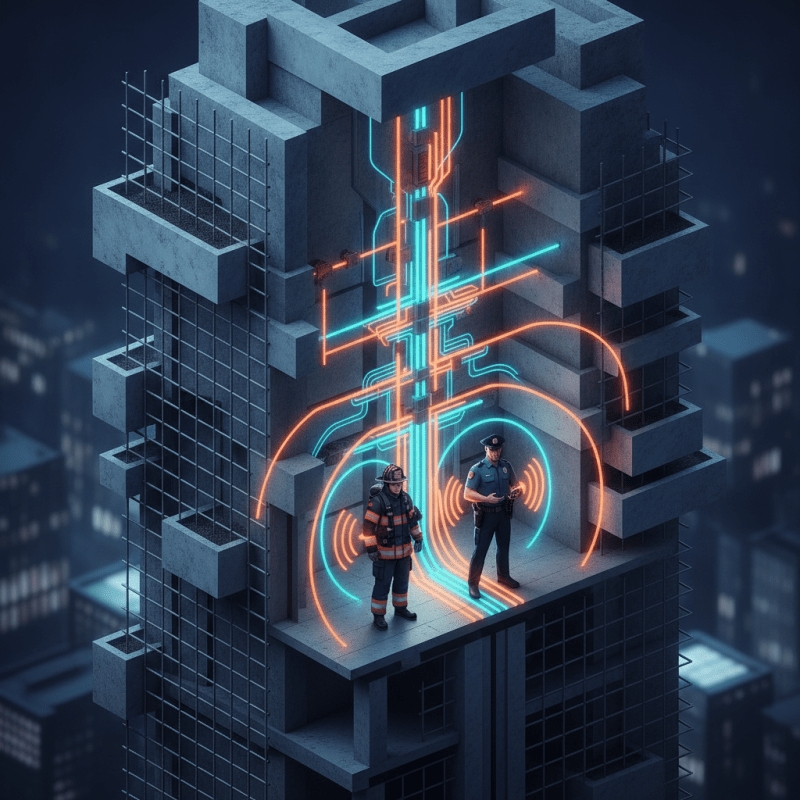
For everyday building occupants, a dropped cell phone call is a frustrating inconvenience. For first responders, however, losing radio contact inside a building can be a matter of life and death. Firefighters, police officers, and paramedics rely heavily on uninterrupted two-way radio communication to coordinate rescue efforts. When building structures block these life-saving signals, the consequences can be catastrophic.
This is where a Distributed Antenna System (DAS) becomes an essential piece of building infrastructure. A properly designed public safety DAS, often referred to as an Emergency Responder Radio Communication System (ERRCS), bypasses these structural barriers. It captures external radio signals and distributes them evenly throughout the building’s interior. Understanding how different materials impact cellular signal propagation is the first step in ensuring your building remains connected and compliant with fire codes.

Understanding Cellular Signal Propagation and Building Materials
To understand why radios fail inside buildings, we first need to look at the science of cellular signal propagation. Signal propagation refers to the way radio frequency (RF) waves travel through the air from a transmitter to a receiver. In a perfect world with no obstacles, these waves travel in a straight line, known as the line of sight. However, the real world is filled with physical barriers that disrupt this journey.
When radio waves strike a physical object, three main things can happen to the signal:
- It can be reflected off the surface.
- It can be refracted (bent) as it passes through.
- It can be absorbed entirely by the material.
Every time a signal hits an obstacle, it loses a certain amount of energy. This gradual weakening of the radio wave is known in the telecommunications industry as signal attenuation.
Different building materials cause varying levels of signal attenuation. The severity of the signal loss depends largely on the density, thickness, and electrical conductivity of the material. A lightweight wooden partition will only cause minor signal degradation, allowing most radio waves to pass through. In contrast, a dense, reinforced concrete wall can absorb almost all the RF energy, leaving the area behind it completely devoid of a usable signal.
This basic principle explains why you might have perfect cell service in the parking lot but zero bars the moment you step into the lobby. A public safety DAS system is specifically designed to overcome this attenuation. By strategically placing internal antennas throughout the facility, a DAS ensures that strong, clear signals bypass the heavy exterior walls and reach deep into the core of the building.
Common Building Materials That Interfere With a DAS System
Not all construction materials are created equal when it comes to radio frequency interference. Some materials are notorious for destroying cellular signal propagation, especially the critical UHF and VHF frequencies used by first responders. If your building contains high amounts of the following materials, it is highly likely you will need an ERRCS to meet local fire code requirements.
The Impact of Concrete and Cinder Blocks
Concrete is one of the most common and essential building materials used in commercial construction today. It provides unmatched structural integrity, excellent fire resistance, and superior soundproofing. Unfortunately, concrete is also one of the absolute worst offenders when it comes to signal attenuation. Its high density makes it incredibly difficult for radio waves to penetrate.
Thick concrete walls essentially act like a sponge for radio frequency energy. The thicker the concrete, the more signal energy is absorbed and lost.
This problem is heavily magnified when you consider areas like basements, underground parking garages, and core structural pillars. These areas are almost always encased in dense concrete, creating massive communication dead zones.
Stairwells and elevator shafts present a particularly dangerous challenge for public safety communication. Fire codes require these specific areas to be heavily reinforced with concrete to provide safe evacuation routes during an emergency. Ironically, this life-saving structural reinforcement makes it nearly impossible for firefighters to use their two-way radios inside the stairwell without the help of a dedicated DAS system.
Metal and Steel Structural Components
If concrete acts like a sponge for radio signals, metal acts like a solid brick wall. Metal is highly conductive, which means it violently disrupts electromagnetic fields and radio waves. Instead of absorbing the signal like concrete, metal surfaces tend to reflect the radio waves back in the direction they came from.
When a building is constructed with heavy steel frames, metal roofs, or metal siding, it can inadvertently create what is known as a Faraday cage. A Faraday cage is an enclosure formed by conductive materials that completely blocks external static and non-static electric fields. In practical terms, this means external cell tower signals and emergency radio frequencies bounce right off the building’s exterior.
Even internal metal components can severely disrupt cellular signal propagation within a building. Large HVAC ductwork, metal filing cabinets, corrugated steel floors, and extensive electrical wiring can scatter signals unpredictably. A professional DAS system designer must carefully map out these internal metal structures to ensure antennas are placed in locations that avoid this heavy interference.
Brick, Masonry, and Mortar
Brick and masonry have been used in construction for centuries, offering excellent durability and aesthetic appeal. Like concrete, brick is a very dense material that causes significant signal attenuation. While a single brick wall might allow some signal to pass through, the cumulative effect of multiple brick walls is often devastating to radio reception.
Older, historic buildings constructed primarily of thick masonry are especially prone to communication dead zones. These structures were built long before the invention of modern wireless communication, and their thick, solid walls were not designed with signal propagation in mind. Upgrading these historic buildings with a modern ERRCS often requires specialized installation techniques to navigate the dense masonry.
The mortar used to hold bricks and blocks together also contributes to the problem. Mortar often retains moisture, and water is exceptionally good at absorbing radio frequency energy. The combination of dense fired clay bricks and moisture-retaining mortar creates a formidable barrier that weak external radio signals simply cannot breach without amplification.
Energy-Efficient Glass and Tinted Windows
Glass was traditionally considered a very radio-transparent material, meaning signals could easily pass right through it. In older buildings with standard single-pane windows, you could often stand near the glass to get better cell phone reception. However, the push for green building standards and energy efficiency has completely changed how modern windows interact with radio waves.
Modern commercial buildings almost exclusively use Low-E (low-emissivity) glass to reduce heating and cooling costs. Low-E glass is manufactured with a microscopic, ultra-thin coating of metal or metallic oxide applied directly to the surface. This metallic layer is incredibly effective at reflecting infrared and ultraviolet light away from the building, keeping the interior cool.
Unfortunately, this metallic coating also does an exceptional job of reflecting radio frequency waves. Buildings with large, beautiful glass facades made of Low-E glass often suffer from terrible cellular signal propagation. The energy-efficient windows bounce the outside public safety signals away, making a specialized DAS system absolutely necessary to bring those signals indoors.
Wood, Drywall, and Insulation
Compared to concrete and metal, wood and standard drywall are relatively friendly to radio signals. They have a much lower density, meaning they cause a significantly lower amount of signal attenuation. A standard interior drywall partition will only cause a minor drop in signal strength, allowing most frequencies to pass through with ease.
However, it is vital to remember that signal loss is a cumulative process. While one drywall partition might only cause a 2 dB (decibel) drop in signal strength, passing through ten drywall partitions can completely destroy a signal. In large office buildings with sprawling floor plans and countless individual rooms, this cumulative attenuation must be carefully calculated.
Furthermore, modern insulation materials can introduce unexpected interference. Foil-backed fiberglass insulation, for example, contains a thin layer of metal that acts as a reflective barrier. Just like Low-E glass or metal roofing, this foil backing can scatter and block radio waves, creating localized dead zones that a public safety DAS system must be tuned to overcome.
Effective Strategies to Overcome Building Materials in Your DAS System
Knowing that building materials destroy signal strength is only half the battle. The true challenge lies in engineering a reliable solution that guarantees first responders have crystal-clear communication in every corner of the facility. Installing an Emergency Responder Radio Communication System (ERRCS) is not a simple plug-and-play operation; it requires sophisticated technology and expert engineering.
To mitigate the massive signal loss caused by concrete, steel, and Low-E glass, RF engineers employ a variety of advanced strategies. These solutions involve capturing the faint outdoor signals, significantly boosting their power, and routing them around the structural barriers. When executed correctly, these strategies transform a dangerous communication dead zone into a fully compliant, safe environment.
Professional RF Design and Predictive Modeling
The absolute most critical step in overcoming building materials is starting with a professional Radio Frequency (RF) design. Before a single cable is pulled or an antenna is mounted, engineers must understand exactly how the building’s architecture will impact cellular signal propagation. Guesswork is never acceptable when dealing with life-safety communication systems.
Professional DAS integrators utilize advanced predictive modeling software, such as iBwave, to create a digital twin of the building. Engineers input the exact building materials, floor plans, and wall thicknesses into the software. The program then simulates how radio waves will travel through the space, accurately calculating the signal attenuation caused by every concrete pillar and metal door.
This predictive modeling allows engineers to design a highly optimized DAS system. They can determine exactly how many antennas are needed and precisely where they should be placed to ensure total coverage. By simulating the environment first, building owners save significant time and money by avoiding costly post-installation adjustments and guaranteeing immediate compliance with fire codes.
Utilizing High-Quality Bi-Directional Amplifiers (BDAs)
The heart of any effective public safety DAS is the Bi-Directional Amplifier, commonly referred to as a BDA. As the name suggests, this vital piece of equipment works in two directions. It pulls in weak radio signals from the outside, amplifies them to a usable level, and pushes them inside. Simultaneously, it captures weak signals from first responder radios inside the building and pushes them back out to the external radio tower.
Without a powerful BDA, the internal antennas of a DAS would have no strong signal to broadcast. High-quality amplifiers from trusted manufacturers are engineered to handle the rigorous demands of emergency communications. These devices are equipped with specialized filters that only amplify specific public safety frequencies, ensuring there is no dangerous interference with standard cellular networks.
Furthermore, BDAs used in an ERRCS are built to strict survivability standards. They are housed in NEMA-4 compliant enclosures that protect the delicate electronics from water and dust during a fire. They are also connected to dedicated battery backup systems, ensuring that even if the building loses total commercial power, the cellular signal propagation for emergency radios remains active and strong.
Strategic Antenna Placement and Distribution
Once the BDA has amplified the signal, it must be distributed effectively throughout the building. This is achieved through a network of specialized coaxial or fiber optic cables connected to strategically placed indoor antennas. The placement of these antennas is the key to bypassing dense building materials and eliminating dead zones.
There are generally two types of antennas used in a DAS system:
- Omni-directional antennas: Broadcast signals in a 360-degree radius, making them ideal for wide-open spaces like cafeterias or large lobbies.
- Directional antennas: Focus the RF energy in a single, targeted beam, much like a flashlight, useful for long hallways or stairwells.
Skilled installers will use directional antennas to punch signals down long, concrete-reinforced hallways or deep into subterranean parking structures. Special attention is always given to critical areas identified by the National Fire Protection Association (NFPA) and the International Fire Code (IFC). Elevator lobbies, stairwells, fire pump rooms, and emergency command centers must have perfectly placed antennas to ensure absolute signal reliability.
Rigorous Signal Benchmark Testing and Grid Testing
To truly prove that a DAS system has successfully overcome the building’s structural barriers, rigorous testing must be performed. Fire marshals will not issue a certificate of occupancy simply because equipment is mounted on the wall. The system must be empirically proven to work through a process called signal benchmark testing.
Before installation, a benchmark test measures the existing signal strength inside the building. This establishes a baseline and proves to the Authority Having Jurisdiction (AHJ) that a system is indeed required. After the DAS is installed, technicians perform extensive grid testing to verify the new coverage.
During grid testing, the building’s floor plan is divided into a grid of 20 or 40 individual squares. Technicians physically walk to the center of every single square and measure the uplink and downlink signal strength using specialized RF spectrum analyzers. Under NFPA 1225 and IFC Section 510, the vast majority of these grid squares must pass the minimum signal strength requirements to ensure the building is safe for emergency responders.
Frequently Asked Questions About Building Materials and Signal Propagation
Why do cell phones and two-way radios almost always fail in stairwells?
Stairwells are specifically designed to be the safest place in a building during a fire, which ironically makes them the worst place for radio communication. Fire codes dictate that stairwells must be enclosed in heavily reinforced, thick concrete to prevent fire and smoke from spreading. This immense density of concrete and steel rebar absorbs nearly all radio frequency energy, entirely blocking cellular signal propagation from the outside.
Can I just use standard building Wi-Fi instead of a dedicated ERRCS or DAS system?
No, standard Wi-Fi is never an acceptable substitute for a dedicated public safety DAS. First responders use specialized UHF, VHF, or 700/800 MHz radio frequencies that are completely separate from Wi-Fi networks. Furthermore, Wi-Fi routers lack the life-safety survivability requirements mandated by fire codes, such as NEMA-4 waterproof enclosures, specialized fire-rated cabling, and mandatory 12-to-24 hour battery backup systems.
Do LEED certification and green building initiatives impact radio signals?
Yes, very significantly. Many of the materials used to achieve LEED certification and high energy efficiency directly hinder radio signals. Low-E glass windows with metallic coatings bounce radio waves away, while heavy foil-backed insulation absorbs signals within the walls. While these materials are excellent for the environment and lower utility bills, they almost guarantee the need for an in-building wireless signal booster to maintain safe communication.
How do I know for sure if my building needs a public safety signal booster?
The only definitive way to know if your building requires an ERRCS is to have a certified professional conduct a baseline signal benchmark test. A technician will evaluate the building’s interior using calibrated spectrum analyzers to measure the exact strength of the local emergency radio channels. If the signal falls below the strict thresholds set by your local fire marshal or the International Fire Code (IFC), a system must be installed to bring the building into compliance.
Building materials are a necessary part of modern architecture, but their negative impact on life-safety communication cannot be ignored. Ensuring that police, fire, and EMS personnel have reliable radio coverage inside your facility is a critical legal and moral responsibility. At Lexico, we specialize in the comprehensive design, installation, testing, and maintenance of Bi-Directional Amplifiers and Emergency Responder Radio Communication Systems. Our expert team understands the complexities of cellular signal propagation and knows exactly how to navigate challenging building structures to guarantee compliance and safety. If you are experiencing dead zones or need to meet strict fire code mandates, reach out to Lexico today to request a professional consultation and signal testing for your property.
Ensure Your Building's Safety - Contact Lexico Today